
Great and Awesome in German: Super, Toll, Ausgezeichnet & More
 Beyond German Team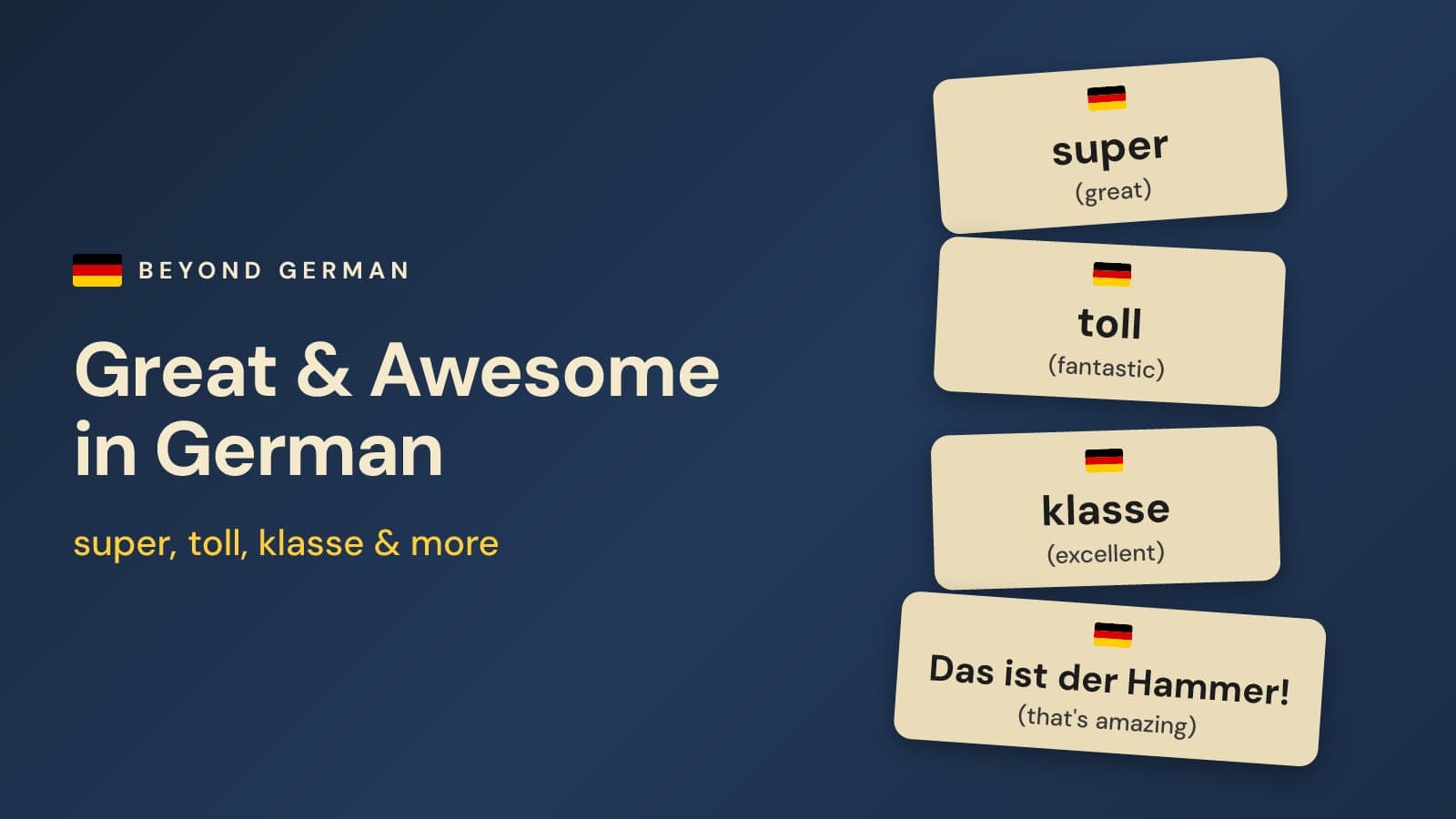
The most common ways to say "great" or "awesome" in German are super, toll and klasse: Das ist super! — That's great! For "excellent", say ausgezeichnet or hervorragend. And "cool" in German is simply cool.
Below you'll find 20 praise words from neutral to enthusiastic, the slang to know (including one word to keep away from your boss), ways to make a compliment stronger, and compliments for people, food and looks. You'll also see why Nicht schlecht! can be big praise in Germany.
German Words for Great, Awesome and Excellent
All of these mean "good" or better. The table runs roughly from neutral to most enthusiastic, and the register column shows where each word is safe to use.
| German | English | Register | Good to know |
|---|---|---|---|
| gut | good | Neutral | Solid praise in German, not lukewarm |
| sehr gut | very good | Neutral | The top grade in German schools |
| super | great, super | Everyday | Works almost anywhere, even at work |
| toll | great, terrific | Everyday | Can be sarcastic: Na toll! |
| klasse | great, first-class | Everyday | Casual and upbeat |
| prima | great, splendid | Everyday | Friendly, a bit old-school |
| spitze | top-notch | Everyday | Cheerful, a bit old-school |
| wunderbar | wonderful | Everyday and formal | Warm and sincere |
| großartig | great, magnificent | Everyday and formal | For big news and achievements |
| ausgezeichnet | excellent | Formal and everyday | Restaurants, reviews, feedback |
| hervorragend | outstanding | Formal | Work, job references, reviews |
| fantastisch | fantastic | Everyday | Enthusiastic; also spelled phantastisch |
| genial | brilliant, genius | Everyday | False friend: it doesn't mean "friendly" |
| cool | cool | Casual | Pronounced as in English |
| krass | insane, wild | Slang | Good or bad: your tone decides |
| geil | awesome | Slang (vulgar origin) | Also means "horny": never in formal settings |
| mega | awesome | Slang | Also boosts other words in speech |
| der Hammer | amazing (literally "the hammer") | Slang | Das ist der Hammer! — That's amazing! |
| läuft | it's going great | Slang | Läuft bei dir! — You're killing it! |
| leiwand | great | Regional (Austria) | Popular in Austria, especially Vienna |
If you only learn three, make them super and toll for everyday life and ausgezeichnet for formal situations. Still building your basic vocabulary? Start with the 50 most common German adjectives.
Everyday Praise: Super, Toll, Klasse and Prima
Super and toll are the words you'll hear most. They fit almost any situation, from a friend's vacation photos to a colleague's idea:
- Das ist eine tolle Idee! — That's a great idea!
- Wir hatten einen tollen Abend. — We had a great evening.
- Super, danke! — Great, thanks!
- Der Film war klasse! — The movie was great!
- Prima, dann bis morgen! — Great, see you tomorrow then!
At work, you'll also hear perfekt as a quick, happy reply: Perfekt, danke! — Perfect, thanks!
Watch your tone, though. Said flatly after bad news, Na toll! and Na super! mean "Oh, great" in the sarcastic sense, just like in English:
- Der Zug hat schon wieder Verspätung? Na super. — The train is late again? Oh, great.
Why It's "ein super Film" but "ein toller Film"
Most praise words take normal adjective endings in front of a noun: ein toller Film, eine tolle Idee. But super, klasse and prima never change, whatever the noun's gender or case:
- Das ist ein super Film. — That's a great movie.
- Sie hatte eine klasse Idee. — She had a great idea.
- Das ist ein toller Film. — That's a great movie.
These words didn't start out as normal adjectives. Klasse, for example, comes from the noun die Klasse (class), as in erste Klasse (first class).
Excellent in German: Ausgezeichnet and Hervorragend
To say "excellent" in German, use ausgezeichnet. It's the polished choice for restaurants, reviews and feedback at work.
- Das Essen war ausgezeichnet! — The food was excellent!
- Ihr Deutsch ist ausgezeichnet. — Your German is excellent.
- Ausgezeichnet, dann machen wir das so. — Excellent, let's do it that way.
Why that word? It comes from the verb auszeichnen (to award, to honor), so something ausgezeichnet is literally "distinguished": Der Film wurde mit einem Oscar ausgezeichnet. — The film won an Oscar. It sounds like "OWS-guh-tsykh-net": the z is pronounced "ts", ei sounds like "eye", and the ch is the soft, breathy sound in ich.
Hervorragend (outstanding) is a notch more formal. It comes from hervorragen, "to stand out", and you'll see it in job references and hotel reviews. Stress the second syllable: "hair-FOR-rah-gent".
- Sie hat hervorragende Arbeit geleistet. — She did outstanding work.
- Vielen Dank für Ihre hervorragende Unterstützung. — Thank you for your outstanding support.
Cool in German: Slang From Krass to Läuft
"Cool" in German is cool: same spelling, same pronunciation. The only difference is that it takes German endings: Das ist ein cooler Typ. — He's a cool guy.
Younger Germans have plenty of stronger options:
- Krass, du sprichst ja fließend Deutsch! — Whoa, you speak fluent German! (Krass means "extreme", so it works for shocking news, too.)
- Die Party war mega! — The party was awesome!
- Das ist der Hammer! — That's amazing! (With an angry tone, it means "That's outrageous!")
- Läuft bei dir! — You're killing it! (Often ironic, right after something has gone wrong.)
Slang ages fast, though: Läuft bei dir was youth word of the year (Jugendwort des Jahres) in 2014 and already sounds a little dated. Cool and super are the safe bets.
Geil: Know It, but Be Careful
You'll hear geil constantly among younger Germans: Das Konzert war geil! — The concert was awesome! But long before it meant "awesome", it meant "horny", and that meaning hasn't gone away. It's fine among friends, but don't use it at work, with older people, in emails or anywhere formal. And never say Ich bin geil (more on that in the mistakes below).
Make It Stronger: Echt, Total, Richtig, Voll
To turn "good" into "really good", add an intensifier. Sehr and wirklich work everywhere; the others are casual.
| Intensifier | Literally | Register | Example |
|---|---|---|---|
| sehr | very | Neutral | Das war sehr gut. — That was very good. |
| wirklich | really, truly | Neutral | Das ist wirklich schön. — That's really beautiful. |
| echt | genuine, real | Casual | Das ist echt lecker! — That's really tasty! |
| richtig | correct, right | Casual | Der Film war richtig gut! — The movie was really good! |
| total | total | Casual | Ich finde das total spannend. — I find that totally exciting. |
| voll | full | Slang | Das ist voll cool! — That's totally cool! |
Two tips. First, the intensifier never takes an ending; only the praise word does: ein echt guter Film (a really good movie), eine richtig tolle Party (a really great party). Second, voll only means "totally" when it boosts another word. Ich bin voll on its own means "I'm drunk" in casual German, not "I'm full" (that's Ich bin satt).
How to Compliment People, Food and Looks
Praising What Someone Did
- Gut gemacht! — Well done!
- Das hast du super gemacht! — You did a great job!
- Das haben Sie sehr gut gemacht. — You did that very well. (formal)
- Du bist der Beste! / Du bist die Beste! — You're the best! (der for a man, die for a woman)
- Respekt! — Respect! / Impressive! (casual, for a real achievement)
- Hut ab! — Hats off!
- Ich bin stolz auf dich. — I'm proud of you.
To say what you think of something, use finden: Ich finde deine Idee super! — I think your idea is great! Our guide on how to give your opinion in German shows how ich finde differs from ich glaube.
Complimenting Food
- Das schmeckt super! — This tastes great!
- Lecker! — Yum! / Delicious!
- Du kochst echt gut! — You're a really good cook!
- Das war köstlich. — That was delicious. (a little more elegant)
- Das schmeckt nach mehr! — I could eat more of this! (literally "This tastes like more!")
In restaurants, the server will often ask Hat es Ihnen geschmeckt? (Did you enjoy your meal?). A happy answer: Ja, danke, ausgezeichnet! — Yes, thanks, excellent! For more ways to talk about taste, see the phrase page for Das schmeckt gut.
Compliments on Looks: Schön, Hübsch or Attraktiv?
- Du siehst toll aus! — You look great!
- Das Kleid steht dir super! — That dress really suits you!
- Schöne Schuhe! — Nice shoes!
Aussehen (to look) is a separable verb, so aus jumps to the end. Stehen plus the dative means "to suit": Das steht dir. — That suits you.
When you describe a person, the three words for "good-looking" aren't interchangeable:
- schön (beautiful) is the strongest and most sincere. Du bist wunderschön. — You're beautiful. It's heartfelt, and usually romantic.
- hübsch (pretty) is lighter and friendlier, and mostly used for women, children and things: ein hübsches Kleid — a pretty dress.
- attraktiv (attractive) sounds neutral and a little detached. Germans use it more to describe someone than to compliment them to their face: Er ist sehr attraktiv. — He's very attractive.
For romantic compliments and pet names, see how to say I love you in German.
How Germans Give and Take Compliments
Many Germans praise sparingly, and when they do, they mean it literally. Over-the-top gushing (Das ist das Beste, was ich je gegessen habe!) can sound insincere. Understatement, on the other hand, is everywhere:
- Nicht schlecht! — Not bad! (often real praise)
- Nicht schlecht, Herr Specht! — Not bad at all! (a playful rhyme: "Not bad, Mr. Woodpecker!")
- Da kann man nicht meckern. — Can't complain about that. (high praise from some people)
There's even a Swabian saying for it: Nicht geschimpft ist genug gelobt, "no criticism is praise enough". So if a German colleague looks at your work and just says Passt (That works), take it as a thumbs-up.
When someone compliments you, keep it simple:
- Danke! — Thanks!
- Danke, das freut mich! — Thanks, I'm glad to hear that!
- Das ist lieb von dir. — That's sweet of you.
- Findest du? — Do you think so?
Common Mistakes
1. Saying "Ich bin geil" to mean "I'm great"
Wrong: Ich bin geil!
Right: Mir geht's super! / Ich freue mich riesig!
Das ist geil describes a thing, but Ich bin geil describes you, and it means "I'm horny". To say you feel great, use Mir geht's super; to say you're thrilled, use Ich freue mich riesig. It's the same trap as Ich bin heiß, one of the common German mistakes English speakers make.
2. Using "genial" to mean friendly
Wrong: Mein Nachbar ist sehr genial. (meaning "very friendly")
Right: Mein Nachbar ist sehr freundlich.
German genial means "brilliant" or "ingenious": Das ist eine geniale Idee! — That's a brilliant idea!
3. Adding endings to super, klasse and prima
Wrong: ein superer Film
Right: ein super Film / ein toller Film
4. Calling a meal "nett"
Wrong: Das Essen war nett.
Right: Das Essen war lecker! / Das Essen war sehr gut!
Nett means nice in the sense of kind: Deine Eltern sind sehr nett is a fine compliment. About food, work or a performance, though, it sounds like faint praise.
5. Putting sehr in front of ausgezeichnet
Wrong: Das war sehr ausgezeichnet.
Right: Das war wirklich ausgezeichnet.
Ausgezeichnet, hervorragend and perfekt are already at the top of the scale, so sehr sounds odd. Use wirklich instead.
Practice
What would you say? Try each one, then check the answers below.
- Your manager's presentation was excellent. Praise it, using Ihre.
- Fill in the gaps: Das ist ein ___ Film. (super) / Das ist ein ___ Film. (toll)
- Make it stronger, casually, with richtig: Das Essen ist gut.
- A friend cooked dinner for you. Give two compliments.
- Your sister just passed her driving test. Praise her and tell her she's the best.
- A German colleague looks at your report and says Nicht schlecht. Should you worry?
Answers: 1. Ihre Präsentation war ausgezeichnet! (or hervorragend) 2. super, toller 3. Das Essen ist richtig gut! 4. Lecker! Das schmeckt super! (or Du kochst echt gut!) 5. Gut gemacht! Du bist die Beste! 6. No: it's probably real praise.
Want more? Brush up on German adjective endings so you can use these words in front of nouns, then test yourself with an A2 German quiz.
FAQ
How do you say "awesome" in German?
In everyday German, say super or toll: Das ist super! Younger people also say mega, krass or Das ist der Hammer! Geil is common too, but it's slang with a vulgar origin.
How do you say "excellent" in German?
Ausgezeichnet ("OWS-guh-tsykh-net") is the standard word. Hervorragend (outstanding) is a little more formal. Both are safe in restaurants, at work and in writing.
What is "cool" in German?
It's cool, pronounced as in English and declined like a German adjective: ein cooles Auto. To boost it, say echt cool or, more casually, voll cool.
Is "geil" a bad word in German?
It's not a swear word, but it's slang, and its older meaning is sexual ("horny"). It's fine among friends; avoid it at work, with people you'd address as Sie, and in writing.
What does "Das ist der Hammer" mean?
"That's amazing!" With an outraged tone, it can also mean "That's outrageous!"
Level Up Your German
Join 1,000+ learners getting weekly tips, grammar shortcuts, and cultural insights.
Share this article
Continue Reading
Colors in German: Rot, Blau, Grün and How to Use Them
All the colors in German with pronunciation, light and dark shades, when colors take endings, how to ask Welche Farbe hat…?, and the color idioms Germans really use.
Merry Christmas in German: Frohe Weihnachten & Traditions
Learn how to say Merry Christmas and Happy New Year in German, plus the traditions from Advent and Nikolaus to Heiligabend and Silvester, with food and market words.
Happy Birthday in German: Alles Gute zum Geburtstag & Wishes
Learn how to say happy birthday in German, from Alles Gute zum Geburtstag to formal card wishes, plus belated wishes, the birthday song and why Germans never congratulate early.