
In My Opinion in German: Meiner Meinung nach, Ich finde & More
 Beyond German Team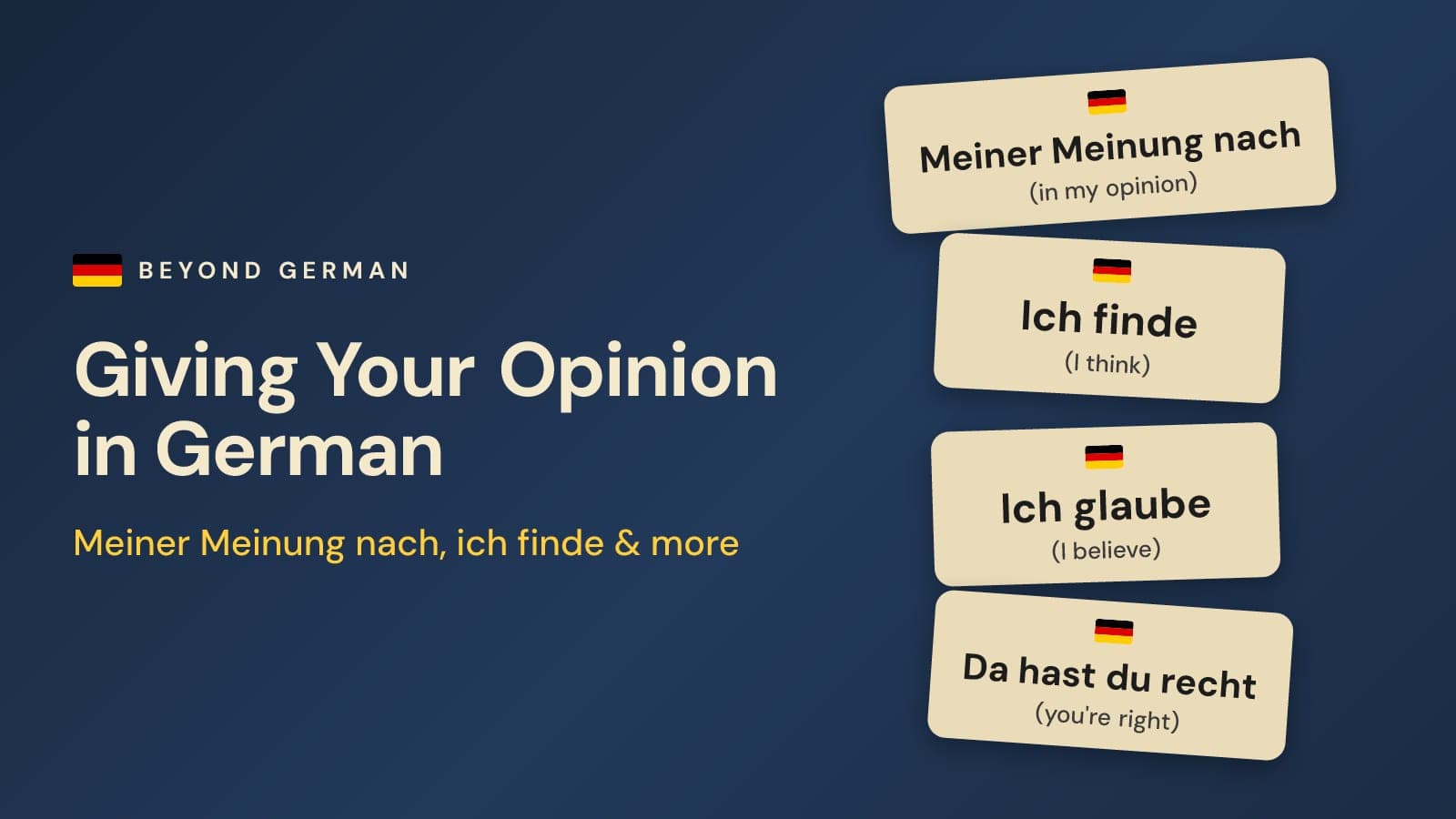
"In my opinion" in German is meiner Meinung nach, and the verb comes straight after it: Meiner Meinung nach ist das eine gute Idee. — In my opinion, that's a good idea. In everyday conversation, though, Germans most often say Ich finde… (I think…): Ich finde das gut. — I think that's good.
Below you'll find nine ways to give your opinion in German, the difference between ich finde, ich denke and ich glaube, the word order rules that trip up most learners, and phrases to agree, disagree and ask what others think.
Meiner Meinung nach: How to Say "In My Opinion"
Meiner Meinung nach combines die Meinung (opinion) with nach (according to), so it literally says "my opinion according to". In this meaning, nach can follow its noun, and it still takes the dative. That's why meine Meinung becomes meiner Meinung (see our guide to German dative prepositions).
The whole phrase counts as one block in position 1, so the verb must come next, before the subject. That's the verb-second rule from German word order basics.
Wrong: Meiner Meinung nach das ist zu teuer. Right: Meiner Meinung nach ist das zu teuer.
- Meiner Meinung nach sollten wir den Zug nehmen. — In my opinion, we should take the train.
- Das ist meiner Meinung nach keine gute Idee. — In my opinion, that's not a good idea.
As the second example shows, you can also put the phrase after the verb. Für mich and Aus meiner Sicht follow the same rule. To talk about someone else's opinion, change the possessive: deiner Meinung nach (your, informal), Ihrer Meinung nach (your, formal), seiner Meinung nach (his) and ihrer Meinung nach (her).
9 Ways to Give Your Opinion in German
Here are the nine opinion starters you'll hear most. The last column shows what happens to the verb.
| German | English | Nuance | Word order |
|---|---|---|---|
| Ich finde, dass… | I think (that)… | The everyday favorite: your own judgment or taste | Verb at the end |
| Ich denke, dass… | I think that… | A thought-through view | Verb at the end |
| Ich glaube, dass… | I believe that… | You're not 100% sure | Verb at the end |
| Meiner Meinung nach… | In my opinion… | Neutral; great for discussions and exams | Verb comes next |
| Ich bin der Meinung, dass… | I'm of the opinion that… | Formal and firm | Verb at the end |
| Ich halte das für… | I consider that… | Rating something with an adjective or noun | Simple sentence |
| Für mich… | For me… | Personal; common in conversation | Verb comes next |
| Aus meiner Sicht… | From my point of view… | Neutral; common at work | Verb comes next |
| Ich bin überzeugt, dass… | I'm convinced that… | Strong certainty | Verb at the end |
- Ich halte das für eine gute Idee. — I think that's a good idea.
- Für mich ist Familie das Wichtigste. — For me, family is the most important thing.
- Aus meiner Sicht gibt es zwei Probleme. — From my point of view, there are two problems.
- Ich bin überzeugt, dass wir das schaffen. — I'm convinced we can do it.
Ich finde vs. Ich denke vs. Ich glaube: What's the Difference?
All three translate as "I think", which is why learners mix them up. The difference is where your opinion comes from.
Ich finde: you've experienced it and you're judging it
Use ich finde for opinions based on your own experience or taste. It's the most common way Germans give an opinion, and it almost always comes with a judgment like gut, langweilig or unfair.
- Ich finde den Film langweilig. — I think the film is boring. (You've seen it.)
Ich glaube: you think so, but you're not sure
Ich glaube signals an assumption. Use it for things you believe are true but can't confirm, including facts.
- Ich glaube, der Film ist langweilig. — I think the film is boring. (You haven't seen it.)
- Ich glaube, der Zug fährt um acht. — I think the train leaves at eight.
Two short answers you'll hear all the time: Ich glaube schon. — I think so. Ich glaube nicht. — I don't think so.
Ich denke: you've thought it through
Ich denke presents a considered view or a conclusion. In everyday speech it overlaps a lot with ich glaube.
- Ich denke, wir sollten früher losfahren. — I think we should leave earlier.
Here's the same idea three ways:
| German | What the listener hears |
|---|---|
| Ich finde das Restaurant gut. | I've eaten there, and I like it. |
| Ich glaube, das Restaurant ist gut. | I haven't been there, but I've heard good things. |
| Ich denke, das Restaurant ist gut. Es ist immer voll. | I'm drawing a conclusion: it's always full. |
Rule of thumb: use finden for judgments, never for facts. Ich finde, der Zug fährt um acht sounds wrong, because a timetable isn't a matter of taste.
Word Order: Where the Verb Goes
Opinion phrases trigger different word order patterns. All four sentences below mean "I think the food is good":
| Pattern | Example | Verb position |
|---|---|---|
| Ich finde, dass… | Ich finde, dass das Essen gut ist. | End of the dass clause |
| Ich finde, … (no dass) | Ich finde, das Essen ist gut. | Position 2, as normal |
| Meiner Meinung nach… | Meiner Meinung nach ist das Essen gut. | Right after the phrase |
| finden + object + adjective | Ich finde das Essen gut. | One simple sentence |
1. Dass sends the verb to the end
Dass (that) starts a subordinate clause, so the conjugated verb goes to the very end. With a modal verb, the modal comes last. Always put a comma before dass.
- Ich glaube, dass er recht hat. — I think he's right.
- Ich bin der Meinung, dass wir mehr Sport machen sollten. — I'm of the opinion that we should exercise more.
2. Without dass, use normal word order
After finden, denken and glauben, you can drop dass, and in speech most people do. The second part is then a normal main clause with the verb in position 2. Keep the comma.
- Ich finde, Deutsch ist eine schöne Sprache. — I think German is a beautiful language.
3. Ich finde das gut: no dass needed
To rate something quickly, use finden + object + adjective: no comma, no dass. The object is in the accusative, so masculine nouns take den.
- Ich finde das gut. — I think that's good. / I like that.
- Ich finde den Film spannend. — I find the film exciting.
Only finden works like this (Ich denke das gut is wrong). For words to rate things with, start with the 50 most common German adjectives.
How to Agree in German
- Da hast du recht. — You're right (about that). Formal: Da haben Sie recht.
- Das stimmt. — That's true. / That's right.
- Genau! — Exactly!
- Das sehe ich auch so. — I see it that way too.
- Ich bin derselben Meinung. — I'm of the same opinion.
- Ich stimme dir zu. — I agree with you. Formal: Ich stimme Ihnen zu.
Note that "you're right" is du hast recht (literally "you have right"). And in Ich stimme zu, the separable verb zustimmen takes the dative: Ich stimme dir zu, not dich.
How to Disagree Politely
Germans tend to be direct, and disagreeing in a discussion isn't seen as rude. Still, a soft start helps.
- Ich sehe das anders. — I see that differently.
- Ich bin anderer Meinung. — I have a different opinion. / I disagree.
- Das stimmt nicht ganz. — That's not quite right.
- Ja, aber… — Yes, but…
- Ich verstehe, was du meinst, aber… — I understand what you mean, but…
You'll often hear the first one flipped: Das sehe ich anders. Ja, aber… is the classic pattern: acknowledge the other person's point, then add yours. Save Quatsch! (Nonsense!) for people you know well.
How to Ask for Someone's Opinion
| Informal (du) | Formal (Sie) | English |
|---|---|---|
| Was meinst du? | Was meinen Sie? | What do you think? |
| Was hältst du von…? | Was halten Sie von…? | What do you think of…? |
| Wie findest du…? | Wie finden Sie…? | How do you like…? |
| Wie siehst du das? | Wie sehen Sie das? | How do you see it? |
Halten von takes the dative: Was hältst du von der Idee? — What do you think of the idea? A typical answer: Ich halte nicht viel davon. — I don't think much of it. Pairs like this are worth learning as a unit; see German verbs with prepositions.
Wie findest du…? asks for a quick judgment: Wie findest du meine neue Wohnung? — How do you like my new apartment? Ich finde sie super! — I think it's great!
Hedging: How to Sound Less Blunt
These small words soften an opinion when you don't want to sound 100% sure:
- eigentlich (actually, in principle): Eigentlich finde ich die Idee gut, aber wir haben keine Zeit. — In principle I like the idea, but we don't have time.
- vielleicht (maybe): Vielleicht hast du recht. — Maybe you're right.
- Ich bin mir nicht sicher (I'm not sure): Ich bin mir nicht sicher, ob das funktioniert. — I'm not sure if that will work.
- eher (rather): Ich finde das eher langweilig. — I find that rather boring.
- Ich würde sagen… (I'd say…): Ich würde sagen, wir warten noch ein bisschen. — I'd say we wait a little longer.
B1 Speaking Exam Tip
Giving your opinion is a core B1 skill. In the Goethe-Zertifikat B1, part 2 of the speaking exam is a short presentation, and one of its five slides asks for the pros and cons (Vor- und Nachteile) and your opinion. Three tips:
- Vary your starters. Rotate Ich finde, dass…, Meiner Meinung nach… and Ich bin der Meinung, dass… instead of repeating Ich denke.
- Give a reason and an example. Add weil or denn plus zum Beispiel. Our guide to weil, denn and deshalb shows the word order for each.
- React to your partner with the agreeing and disagreeing phrases above.
Here's a model answer for the pros-and-cons slide on working from home:
Ein Vorteil von Homeoffice ist, dass man keine Zeit für den Arbeitsweg braucht. Ein Nachteil ist, dass man weniger Kontakt zu den Kollegen hat. Meiner Meinung nach ist eine Mischung am besten, zum Beispiel zwei Tage zu Hause und drei Tage im Büro.
One advantage of working from home is that you don't need any time for the commute. One disadvantage is that you have less contact with your colleagues. In my opinion, a mix is best, for example two days at home and three days in the office.
Common Mistakes
1. Translating "in my opinion" word for word
Wrong: In meiner Meinung ist das gut. Right: Meiner Meinung nach ist das gut.
German doesn't use in here. Learn meiner Meinung nach as one fixed block.
2. Keeping English word order after meiner Meinung nach
Wrong: Meiner Meinung nach das ist gut. Right: Meiner Meinung nach ist das gut.
The verb must be in position 2, so it comes before the subject.
3. Forgetting to move the verb after dass
Wrong: Ich finde, dass das ist gut. Right: Ich finde, dass das gut ist.
4. Saying "Ich habe die Meinung"
Wrong: Ich habe die Meinung, dass… Right: Ich bin der Meinung, dass…
5. Saying "Du bist richtig" for "you're right"
Wrong: Du bist richtig. Right: Du hast recht.
In German, you have right (recht haben). Richtig describes answers and facts: Das ist richtig. — That's correct.
For more traps like these, see common German mistakes English speakers make.
Practice
Put the words in the right order, then check your answers.
- Meiner Meinung nach / ist / das Wetter / heute / schön
- Ich finde, dass / das Ticket / ist / zu teuer
- Ich glaube, dass / er / kommt / heute / nicht
- Ich / den Kaffee / finde / hier / sehr gut
Answers:
- Meiner Meinung nach ist das Wetter heute schön.
- Ich finde, dass das Ticket zu teuer ist.
- Ich glaube, dass er heute nicht kommt.
- Ich finde den Kaffee hier sehr gut.
If the dass sentences felt tricky, review German subordinate clauses, then test yourself with the B1 German quiz.
Keep learning:
FAQ
How do you say "in my opinion" in German?
Say meiner Meinung nach, followed directly by the verb: Meiner Meinung nach ist das richtig. In conversation, Ich finde… is even more common, and Ich bin der Meinung, dass… is a more formal option.
Is it "meiner Meinung nach" or "nach meiner Meinung"?
Both are correct, but meiner Meinung nach is far more common. Never say in meiner Meinung.
What's the difference between ich finde, ich denke and ich glaube?
Ich finde gives a judgment based on your own experience or taste. Ich glaube means you think something is true but aren't sure. Ich denke is a considered view and often overlaps with ich glaube.
How do you say "I agree" in German?
Ich stimme dir zu (informal) or Ich stimme Ihnen zu (formal). In conversation, Das stimmt, Genau and Da hast du recht are even more common.
Level Up Your German
Join 1,000+ learners getting weekly tips, grammar shortcuts, and cultural insights.
Share this article
Continue Reading
Colors in German: Rot, Blau, Grün and How to Use Them
All the colors in German with pronunciation, light and dark shades, when colors take endings, how to ask Welche Farbe hat…?, and the color idioms Germans really use.
I Love You in German: Ich liebe dich vs. Ich hab dich lieb
Learn when to say Ich liebe dich and when to say Ich hab dich lieb, plus German pet names, romantic phrases, texting codes like HDL and Valentine's Day customs.
Great and Awesome in German: Super, Toll, Ausgezeichnet & More
Super, toll, klasse or ausgezeichnet? Learn the German words for great, awesome, excellent and cool, from neutral to slang, plus compliments for people, food and looks.