
Dass vs Das: When to Use Dass or Das in German (Easy Test)
 Beyond German Team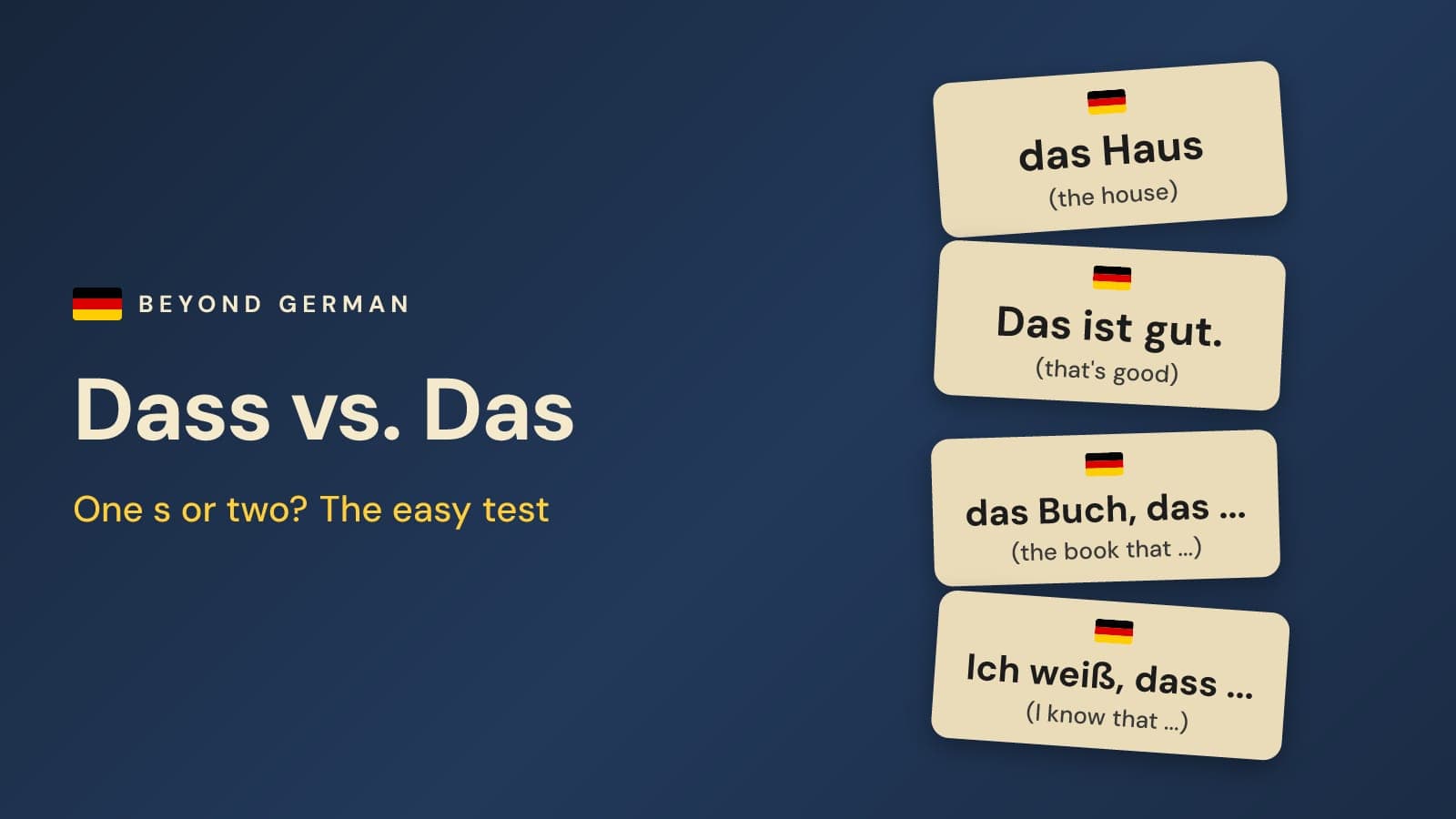
Das with one s is an article or a pronoun: it goes with a noun or points to something, as in das Haus (the house), Das ist gut (That's good) and das Haus, das ich kaufe (the house that I'm buying). Dass with double s is a conjunction meaning "that": it joins two clauses and sends the verb to the end, as in Ich weiß, dass du recht hast (I know that you're right). The quick test: if you can replace the word with dieses, jenes or welches, write das. If you can't, write dass.
If you mix them up, you're in good company: the two words sound exactly the same, English uses "that" for both, and even native speakers confuse them. Below you'll find the four jobs of das and dass, the replacement test, comma rules, sodass, common mistakes and a practice exercise.
Quick Overview: Das or Dass?
| Word | Job | English | Example |
|---|---|---|---|
| das | Article (before a neuter noun) | the | Das Haus ist alt. |
| das | Demonstrative pronoun | that, this | Das ist gut. |
| das | Relative pronoun | that, which, who | das Haus, das ich kaufe |
| dass | Conjunction | that | Ich weiß, dass du recht hast. |
The key insight: das always points to something, whether that's a noun, a thing or an idea. Dass doesn't. It introduces a whole statement with its own subject and verb, which is why no pointing word like dieses can replace it.
1. Das as an Article: "The"
Das is the definite article ("the") for neuter nouns in the nominative and accusative singular:
- Das Haus ist sehr alt. — The house is very old.
- Ich kaufe das Buch. — I'm buying the book.
- Das Mädchen spielt im Garten. — The girl is playing in the garden.
Replacement test: dieses Haus, dieses Buch. It works, so it's das. Not sure whether a noun is neuter? Endings help: every diminutive ending in -chen is neuter, which is why Mädchen (girl) takes das. Our guide to der, die, das gender rules covers the other clues.
2. Das as a Demonstrative Pronoun: "That, This"
On its own, without a noun after it, das means "that" or "this". It points to something you can see or something that was just said:
- Das ist gut. — That's good.
- Das stimmt. — That's right.
- Was kostet das? — How much is that?
- Das weiß ich nicht. — I don't know (that).
Replacement test: Dieses ist gut. It sounds stiff, but it makes sense, so it's das.
3. Das as a Relative Pronoun: "That, Which, Who"
After a comma, das can start a relative clause: a mini sentence that describes a neuter noun. Like every relative clause, it sends the verb to the end:
- Das ist das Haus, das ich kaufen möchte. — That's the house (that) I'd like to buy.
- Das Buch, das du mir geschenkt hast, ist super. — The book (that) you gave me is great.
- Das Mädchen, das dort steht, ist meine Schwester. — The girl who's standing over there is my sister.
Replacement test: das Haus, welches ich kaufen möchte works, so it's das. Relative das always points back to a neuter noun; other genders take der or die (der Mann, der dort steht).
Unlike English, German never drops the relative pronoun: "the house I'm buying" is always das Haus, das ich kaufe. The pronoun also changes with its case. In the dative, it's dem: das Kind, dem ich helfe — the child I'm helping. You'll find every form in our guide to German relative clauses.
4. Dass as a Conjunction: "That"
Dass doesn't point to anything. It's a conjunction that links a whole statement to the main clause, often after verbs of saying, thinking and feeling. It starts a subordinate clause, so the conjugated verb goes to the very end:
[Main clause], dass + [subject] + [middle] + [VERB]- Ich weiß, dass du recht hast. — I know (that) you're right.
- Er sagt, dass er morgen kommt. — He says (that) he's coming tomorrow.
- Ich glaube, dass ich morgen arbeiten muss. — I think I have to work tomorrow.
- Ich hoffe, dass das Wetter am Wochenende gut ist. — I hope the weather is nice this weekend.
Replacement test: Ich weiß, dieses du recht hast? Nonsense, so it's dass. With two verbs, the conjugated one goes last (arbeiten muss). And notice dass das Wetter in the last example: first the conjunction, then the article of das Wetter.
Common Phrases With Dass
| German | English |
|---|---|
| Ich weiß, dass… | I know (that)… |
| Ich glaube, dass… | I think / believe (that)… |
| Ich finde, dass… | I think (that)… (opinion) |
| Ich hoffe, dass… | I hope (that)… |
| Ich bin froh, dass… | I'm glad (that)… |
| Es ist wichtig, dass… | It's important (that)… |
| Es tut mir leid, dass… | I'm sorry (that)… |
To share a view, see our guide on how to give your opinion in German. To apologize, learn Tut mir leid, dass ich zu spät bin (Sorry I'm late).
Starting a Sentence With Dass
A dass clause can also come first. It then fills position 1, so the main clause continues with its verb, following the verb-second rule from our guide to German word order:
- Dass du gekommen bist, freut mich sehr. — I'm really glad you came.
Leaving Out Dass
After verbs like glauben, denken, finden, hoffen and sagen, you can drop dass, just as English drops "that". The verb then moves back to position 2. Keep the comma:
- Ich glaube, dass er recht hat. → Ich glaube, er hat recht. — I think he's right.
After phrases like es ist wichtig or ich bin froh, keep dass. The relative pronoun das can never be dropped.
The Replacement Test: Dieses, Jenes or Welches?
Whenever you're unsure, replace the word with dieses (this), jenes (that) or welches (which), and leave the rest of the sentence as it is:
- If one of them makes sense, write das.
- If none of them does, write dass.
Dieses and jenes fit the article and the demonstrative; welches fits the relative pronoun. Jenes is rare in modern speech, so dieses and welches are usually all you need. The result may sound stiff, and that's fine: it only has to make sense. Here's the test on a classic sentence with all four uses:
Ich glaube, dass das das Haus ist, das ich kaufen will. — I think that's the house I want to buy.
| Word | Replace it | Result |
|---|---|---|
| 1. dass | Ich glaube, dieses das Haus ist… | Nonsense → dass (conjunction) |
| 2. das | …, dass dieses das Haus ist… | Makes sense → das (demonstrative) |
| 3. das | …, dass das dieses Haus ist… | Makes sense → das (article) |
| 4. das | …das Haus ist, welches ich kaufen will. | Makes sense → das (relative pronoun) |
Shortcut for English speakers: if "which", "who", "this" or "the" works in English, it's das. If "that" introduces a whole statement (I think that…, I hope that…), it's dass.
Tricky Case: Nouns Followed by Das or Dass
Some nouns can be followed by either word, and only the meaning decides:
- Das Problem ist, dass wir keine Zeit haben. — The problem is that we don't have time.
- Das ist ein Problem, das wir lösen können. — That's a problem (that) we can solve.
- Ich habe das Gefühl, dass er lügt. — I have a feeling (that) he's lying.
In the first and third sentences, the clause says what the problem or the feeling is, and welches doesn't fit: dass. In the second, ein Problem, welches wir lösen können works: das.
Comma Rules for Das and Dass
Relative das and dass both start a subordinate clause, and German always sets subordinate clauses off with commas, even where English uses none:
| Structure | Comma? | Example |
|---|---|---|
| das + noun (article) | No | Ich kaufe das Haus. |
| das alone (demonstrative) | No | Das ist gut. |
| das (relative pronoun) | Before it, and after the clause if the sentence goes on | Das Haus, das ich kaufe, ist alt. |
| dass (conjunction) | Before it (unless it starts the sentence), and after the clause if the sentence goes on | Ich weiß, dass du kommst. / Dass du kommst, freut mich. |
The comma alone can't decide, because relative das and dass both follow one. But in the middle of a sentence, with no comma in front, das is almost always the article or the demonstrative.
Sodass or So Dass?
Sodass introduces a result, like English "so" or "with the result that". It's built on dass, so it has double s and sends the verb to the end. Sodass and so dass are both correct, and Duden recommends sodass. Either way, the comma goes before the whole thing:
- Der Zug hatte Verspätung, sodass ich zu spät zur Arbeit kam. — The train was delayed, so I was late for work.
- Es hat stark geregnet, so dass wir zu Hause geblieben sind. — It rained heavily, so we stayed at home.
So … Dass: "So … That"
When so belongs to an adjective or adverb, as in "so tired that", the two words split up and the comma goes before dass:
- Ich war so müde, dass ich sofort eingeschlafen bin. — I was so tired (that) I fell asleep right away.
One more trap: English "so that" can also mean "in order that". For a purpose, German uses damit, not sodass: Ich spreche langsam, damit du mich verstehst. — I'm speaking slowly so (that) you can understand me.
Common Mistakes With Das and Dass
| Wrong | Right | Why |
|---|---|---|
| Ich weiß, das du recht hast. | Ich weiß, dass du recht hast. | It introduces a statement, and welches doesn't fit. |
| Das Buch, dass ich lese, ist spannend. | Das Buch, das ich lese, ist spannend. | Das Buch, welches ich lese works: it's a relative pronoun. |
| Ich glaube, dass er hat recht. | Ich glaube, dass er recht hat. | Dass sends the verb to the end. |
| Ich hoffe dass du kommst. | Ich hoffe, dass du kommst. | A comma always separates the dass clause from the main clause. |
| Das Haus das ich kaufe ist alt. | Das Haus, das ich kaufe, ist alt. | A relative clause in mid-sentence needs a comma on both sides. |
| Das ist alles, das ich weiß. | Das ist alles, was ich weiß. | After alles, the relative pronoun is was. |
| Ich habe gehört, daß… | Ich habe gehört, dass… | Daß is the old spelling from before the 1996 reform. |
Practice: Das or Dass?
Fill in each gap with das or dass. Use the replacement test!
- Ich hoffe, ___ du bald wieder gesund bist.
- ___ Auto, ___ vor dem Haus steht, gehört meinem Nachbarn.
- ___ ist eine sehr gute Idee!
- Es ist schade, ___ du nicht kommen kannst.
- Ist ___ das Buch, ___ du mir empfohlen hast?
- Er war so nervös, ___ er kein Wort gesagt hat.
- Ich habe das Gefühl, ___ ich ___ schon einmal gesehen habe.
- ___ du Deutsch lernst, finde ich toll.
Answers:
- Ich hoffe, dass du bald wieder gesund bist. — I hope you'll be better soon. (No replacement fits.)
- Das Auto, das vor dem Haus steht, gehört meinem Nachbarn. — The car parked in front of the house belongs to my neighbor. (Dieses Auto, welches…)
- Das ist eine sehr gute Idee! — That's a really good idea! (Dieses ist…)
- Es ist schade, dass du nicht kommen kannst. — It's a shame you can't come.
- Ist das das Buch, das du mir empfohlen hast? — Is that the book you recommended to me? (Ist dieses das Buch, welches…)
- Er war so nervös, dass er kein Wort gesagt hat. — He was so nervous (that) he didn't say a word.
- Ich habe das Gefühl, dass ich das schon einmal gesehen habe. — I have a feeling I've seen that before. (Dieses fits only the second gap.)
- Dass du Deutsch lernst, finde ich toll. — I think it's great that you're learning German.
Want more practice?
- See more examples on our word page for the relative pronoun der, die, das.
- Drill verb-at-the-end word order with weil vs denn vs deshalb.
- Tackle another classic mix-up: nicht vs kein.
- Test yourself in the B1 German quiz.
FAQ
How do I know whether to write das or dass?
Replace the word with dieses, jenes or welches. If one of them makes sense, write das. If none does, write dass.
Do das and dass sound different?
No, they're pronounced exactly the same. That's why even native speakers mix them up in writing.
Is daß still correct?
No. Daß was the standard spelling before the 1996 spelling reform. Today it's dass, though you'll still see daß in older books and on old signs.
Can you leave out dass in German?
Yes, after verbs like glauben, denken and sagen, but then the verb goes back to position 2: Ich glaube, er kommt.
Is it sodass or so dass?
Both are correct, and Duden recommends sodass. Never write so das: the word is built on the conjunction dass.
Level Up Your German
Join 1,000+ learners getting weekly tips, grammar shortcuts, and cultural insights.
Share this article
Continue Reading
Hobbies in German: Was machst du gern? Freizeit Vocabulary
How to talk about hobbies in German: ask Was machst du in deiner Freizeit?, answer with gern, lieber and am liebsten, and learn Freizeit vocabulary by category.
Directions in German: Links, Rechts, Geradeaus & How to Ask
How to ask for directions in German (Wie komme ich zum Bahnhof?), understand links, rechts and geradeaus, plus city vocabulary, two dialogues and common mistakes.
Rooms in German: House & Furniture Vocabulary With Plurals
Rooms, furniture and appliances in German with articles and plurals, plus how to describe your home, which floor the Erdgeschoss is, and why Germans air their rooms.