
Nicht vs Kein: German Negation Made Simple (+ Where Nicht Goes)
 Beyond German Team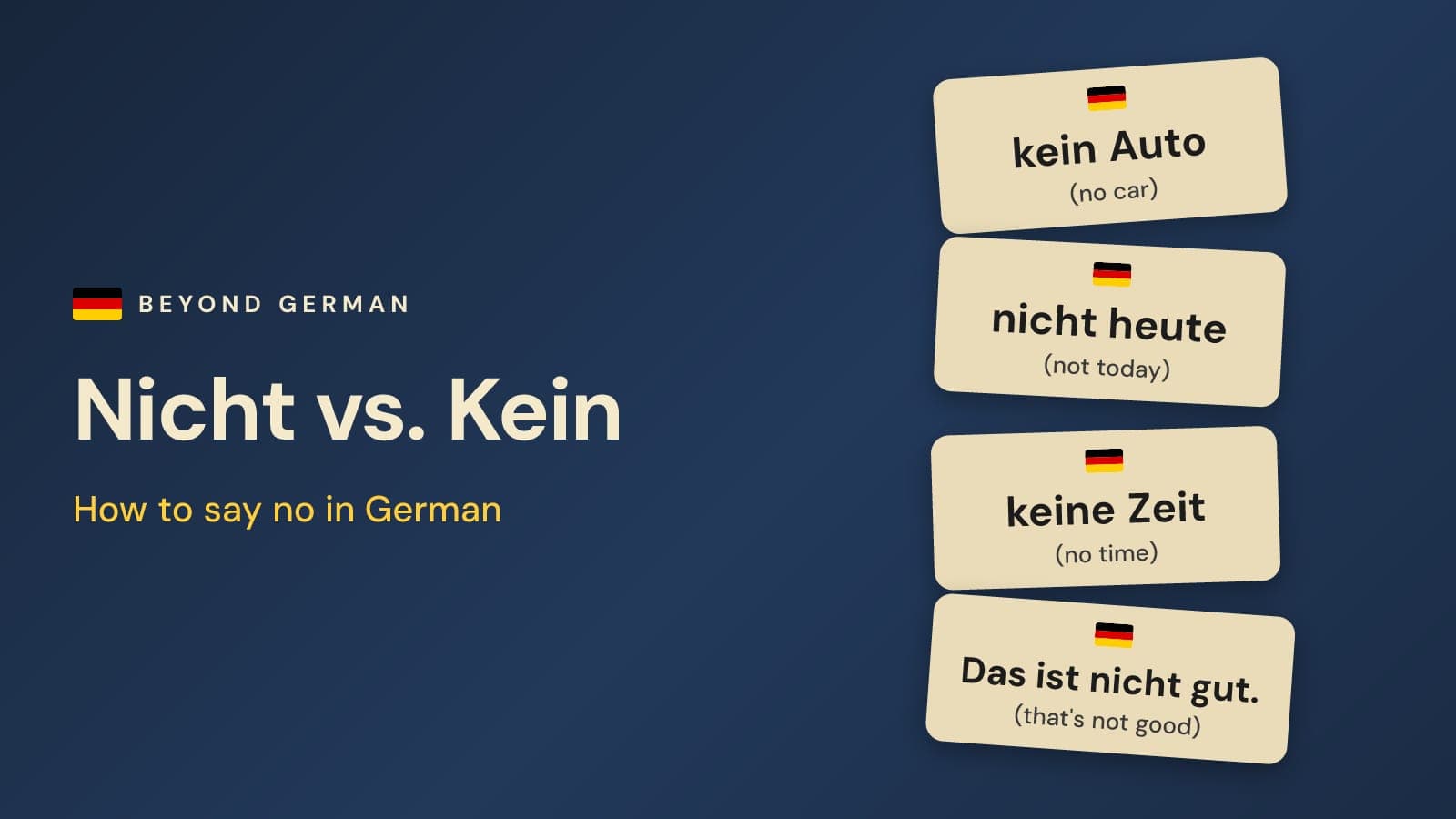
Use kein to negate a noun that would otherwise have ein or no article at all: Ich habe kein Auto. — I don't have a car. Use nicht for everything else, including verbs, adjectives, adverbs, names and nouns with der, die, das or mein: Ich arbeite heute nicht. — I'm not working today.
The trickier part is where nicht goes, because its position changes what you're negating. That's all below, along with the kein endings, sondern, doch, combos like kein … mehr and a practice exercise.
Quick Overview: Kein or Nicht?
| Word | What it negates | Example | English |
|---|---|---|---|
| kein | Nouns with ein / eine | Ich habe kein Auto. | I don't have a car. |
| kein | Nouns with no article | Ich habe keine Zeit. | I don't have time. |
| nicht | Verbs | Ich rauche nicht. | I don't smoke. |
| nicht | Adjectives and adverbs | Das ist nicht teuer. | That's not expensive. |
| nicht | Nouns with der, die, das or mein, dein… | Das ist nicht mein Handy. | That's not my phone. |
| nicht | Names and pronouns | Ich kenne ihn nicht. | I don't know him. |
So you only need one question: would the noun have ein or no article? Then it's kein. Otherwise, it's nicht. (A few fixed verb + noun pairs take nicht, like Ich fahre nicht Ski. — I don't ski. With languages, both work: Ich spreche kein Deutsch and Ich spreche nicht Deutsch.)
Memory trick: kein is basically nicht + ein squeezed into one word. If "no" + noun works in English (I have no car, no time), use kein.
1. Kein: For Nouns With Ein or No Article
Kein means "no", "not a" or "not any". It goes right in front of the noun, where ein would be, or where there's no article at all:
- Ich habe einen Bruder. → Ich habe keinen Bruder. — I have a brother. → I don't have a brother.
- Das ist eine gute Idee. → Das ist keine gute Idee. — That's a good idea. → That's not a good idea.
- Ich habe Kinder. → Ich habe keine Kinder. — I have children. → I don't have any children.
- Wir haben Milch. → Wir haben keine Milch. — We have milk. → We don't have any milk.
- Er ist Arzt. → Er ist kein Arzt. — He's a doctor. → He isn't a doctor.
Nouns without an article include plurals, things you can't count (milk, money, time) and jobs, since German says Er ist Arzt without "a". The same goes for phrases like Hunger haben: Ich habe keinen Hunger. — I'm not hungry. You'll hear this pattern all day: Ich habe keine Zeit (I don't have time), Ich habe keine Lust (I don't feel like it), Kein Problem! (No problem!) and Keine Ahnung (No idea).
Kein Endings: The Declension Table
Kein takes the same endings as ein (and mein, dein, sein…), except that ein has no plural and kein does. The ending depends on the noun's gender and case. If the four cases are new to you, start with our German cases overview.
| Case | Masculine (der Hund) | Feminine (die Katze) | Neuter (das Auto) | Plural (die Kinder) |
|---|---|---|---|---|
| Nominative | kein Hund | keine Katze | kein Auto | keine Kinder |
| Accusative | keinen Hund | keine Katze | kein Auto | keine Kinder |
| Dative | keinem Hund | keiner Katze | keinem Auto | keinen Kindern |
| Genitive | keines Hundes | keiner Katze | keines Autos | keiner Kinder |
You'll use the accusative row most, because haben and es gibt take accusative objects. Only masculine nouns change there: Hier gibt es keinen Supermarkt. — There's no supermarket here.
Adjectives after kein take the same endings as after ein, and -en in the plural: Das ist kein guter Plan. — That's not a good plan. Wir haben keine guten Ideen. — We don't have any good ideas. Our post on German adjective endings explains the system.
2. Nicht: For Everything Else
Nicht means "not". It negates verbs, adjectives and adverbs, as well as names, pronouns and nouns that already have a definite article (der, die, das) or a possessive (mein, dein, unser…):
- Ich rauche nicht. — I don't smoke.
- Der Film war nicht schlecht. — The movie wasn't bad.
- Ich finde den Schlüssel nicht. — I can't find the key.
- Das ist nicht Anna. — That's not Anna.
The article makes all the difference:
- Das ist kein Problem. — That's no problem.
- Das ist nicht mein Problem. — That's not my problem.
- Ich habe kein Buch gelesen. — I haven't read a book.
- Ich habe das Buch nicht gelesen. — I haven't read the book.
Germans even have an idiom built on nicht + possessive: Das ist nicht mein Bier, literally "That's not my beer", meaning "That's none of my business".
3. Where Does Nicht Go?
Kein is easy to place: it sits where the article would be. Nicht moves around, and its position changes what you're negating. If the verb-second rule is new to you, start with German word order basics. Then remember four rules.
Whole Sentence: Nicht Goes Toward the End
To negate the whole statement, put nicht after the conjugated verb, after objects and after time words like heute or am Montag. With a one-part verb, that's usually the very end:
- Ich arbeite heute nicht. — I'm not working today.
- Ich kenne den Mann nicht. — I don't know the man.
Two-Part Verbs: Nicht Goes Before the Second Part
With modal verbs, the perfect tense and separable verbs, part of the verb goes to the end. Nicht comes before that part:
- Ich kann heute nicht kommen. — I can't come today.
- Ich habe den Film nicht gesehen. — I haven't seen the movie.
- Er ruft mich nicht an. — He doesn't call me.
Adjectives, Adverbs and Prepositional Phrases: Nicht Goes Before Them
Even when you negate the whole sentence, nicht comes before an adjective after sein, an adverb like gut or gern, and a prepositional phrase for a place, a direction or an object (warten auf):
- Das Hotel ist nicht teuer. — The hotel isn't expensive.
- Ich tanze nicht gern. — I don't like dancing.
- Wir fahren morgen nicht nach Berlin. — We're not going to Berlin tomorrow.
- Ich warte nicht auf dich. — I'm not waiting for you.
One Part Only: Nicht Goes Right Before It
To negate one specific word or phrase, put nicht directly in front of it. This usually sets up a contrast with sondern:
- Ich komme nicht heute, sondern morgen. — I'm not coming today, I'm coming tomorrow.
- Nicht alle Deutschen trinken Bier. — Not all Germans drink beer.
In a subordinate clause, nicht goes before the verb at the end: …, weil ich heute nicht arbeite. — … because I'm not working today. For how nicht fits in with time, manner and place, see our guide to German word order and TeKaMoLo.
4. Nicht … Sondern and Kein … Sondern
Sondern means "but" in the sense of "but rather" or "instead". It only follows a negation, usually nicht or kein, and it replaces the wrong information with the right one:
- Ich komme nicht aus England, sondern aus Irland. — I'm not from England, I'm from Ireland.
- Das ist kein Hund, sondern ein Wolf! — That's not a dog, it's a wolf!
- Sie spricht nicht nur Deutsch, sondern auch Französisch. — She speaks not only German but also French.
Don't mix it up with aber, which adds something while both parts stay true. Sondern corrects:
- Die Wohnung ist nicht groß, aber sie ist günstig. — The apartment isn't big, but it's cheap.
- Die Wohnung ist nicht groß, sondern riesig! — The apartment isn't big, it's huge!
Sondern always has a comma before it and doesn't change the word order. Our guide to obwohl vs trotzdem compares it with aber and doch.
5. Doch: Saying "Yes" to a Negative Question
When someone asks a question with nicht or kein and the honest answer is "yes", German doesn't use ja. It uses doch, which contradicts the negative:
| Question | Agreeing ("no") | Contradicting ("yes") |
|---|---|---|
| Hast du keinen Hunger? — Aren't you hungry? | Nein, ich habe keinen Hunger. — No, I'm not. | Doch, ich habe Hunger! — Yes, I am! |
| Kommst du nicht mit? — Aren't you coming? | Nein, ich komme nicht mit. — No, I'm not. | Doch, ich komme mit! — Yes, I am! |
It works for negative statements too: „Das stimmt nicht!“ – „Doch!“ — "That's not true!" "Yes, it is!" A plain ja would leave people unsure what you mean. Doch has plenty of other jobs, too; see how to use doch in German.
6. Noch Nicht, Nicht Mehr and Kein … Mehr
Add noch (still, yet) or mehr (more) to say "not yet" and "not anymore". The rule stays the same: kein for nouns with ein or no article, nicht for everything else.
| German | English | Example |
|---|---|---|
| noch nicht | not yet | Ich bin noch nicht fertig. — I'm not ready yet. |
| noch kein | no … yet | Ich habe noch keine Wohnung. — I don't have an apartment yet. |
| nicht mehr | not anymore | Ich wohne nicht mehr in Berlin. — I don't live in Berlin anymore. |
| kein … mehr | no more, none left | Wir haben keine Milch mehr. — We're out of milk. |
| noch nie | never (before) | Ich war noch nie in Wien. — I've never been to Vienna. |
| gar nicht / gar kein | not at all / no … at all | Ich habe gar keine Zeit. — I have no time at all. |
Note that mehr comes after the noun: keine Milch mehr, never keine mehr Milch. And the opposite of noch nicht is schon (already): Bist du schon fertig? – Nein, noch nicht. — Are you done already? – No, not yet.
Common Mistakes With Nicht and Kein
| Wrong | Right | Why |
|---|---|---|
| Ich habe nicht ein Auto. | Ich habe kein Auto. | Nicht + ein becomes kein. |
| Ich habe nicht Zeit. | Ich habe keine Zeit. | Nouns without an article take kein. |
| Ich habe kein Bruder. | Ich habe keinen Bruder. | Masculine accusative: keinen. |
| Das ist kein mein Handy. | Das ist nicht mein Handy. | Possessives like mein take nicht. |
| Ich nicht arbeite heute. | Ich arbeite heute nicht. | Nicht comes after the conjugated verb. |
| Ich habe nicht das Buch gelesen. | Ich habe das Buch nicht gelesen. | Nicht goes before the participle. Nicht das Buch only works as a contrast (…, sondern die Zeitung). |
| Ich habe nicht mehr Geld. (meaning: none left) | Ich habe kein Geld mehr. | Nicht mehr Geld means "not more money". |
| Ich komme nicht aus England, aber aus Irland. | …, sondern aus Irland. | To correct a negation, use sondern. |
| Hast du keinen Hunger? – Ja, ich habe Hunger. | – Doch, ich habe Hunger. | To contradict a negative question, use doch. |
Practice: Nicht or Kein?
Fill in nicht or the right form of kein (1–6), then follow the instructions (7–9):
- Ich habe heute ___ Zeit.
- Das Wetter ist ___ schön.
- Er trinkt ___ Alkohol.
- Ich kenne die Frau ___.
- Das ist ___ mein Schlüssel.
- Sie hat ___ Geschwister.
- Ich habe den Film gesehen. (Negate the whole sentence.)
- Wir haben noch Brot. (Say there's none left.)
- Hast du keine Zeit? (Answer that you do have time.)
Answers:
- Ich habe heute keine Zeit. — I don't have time today. (no article)
- Das Wetter ist nicht schön. — The weather isn't nice. (adjective)
- Er trinkt keinen Alkohol. — He doesn't drink alcohol. (no article; der Alkohol, accusative)
- Ich kenne die Frau nicht. — I don't know the woman. (definite article)
- Das ist nicht mein Schlüssel. — That's not my key. (possessive)
- Sie hat keine Geschwister. — She doesn't have any siblings. (plural)
- Ich habe den Film nicht gesehen. — I haven't seen the movie.
- Wir haben kein Brot mehr. — We're out of bread.
- Doch, ich habe Zeit! — Yes, I do have time!
Want more practice?
- Review keinen and the other accusative endings in our guide to the German accusative case.
- Test yourself in the A1 German quiz.
- Tackle another classic mix-up: dass vs das.
FAQ
What's the difference between nicht and kein?
Kein negates nouns that would have ein or no article (kein Auto, keine Zeit). Nicht negates everything else: verbs, adjectives, adverbs, names and nouns with der, die, das or mein.
Where does nicht go in a German sentence?
To negate the whole sentence, nicht goes after the verb, objects and time words, but before a second verb part, adjectives and places. To negate one word, put nicht right before it.
Can you ever say "nicht ein"?
Yes, when ein means "one" and you want to stress it: Ich habe nicht ein Wort verstanden. (I didn't understand a single word.) Otherwise, use kein.
What's the difference between nicht and nichts?
Nicht means "not", and nichts means "nothing": Ich weiß nicht. (I don't know.) vs. Ich weiß nichts. (I don't know anything.)
Is kein the same as nein?
No. Nein is "no" as an answer. Kein means "no" or "not a" before a noun: Nein, ich habe kein Auto. (No, I don't have a car.)
Level Up Your German
Join 1,000+ learners getting weekly tips, grammar shortcuts, and cultural insights.
Share this article
Continue Reading
Hobbies in German: Was machst du gern? Freizeit Vocabulary
How to talk about hobbies in German: ask Was machst du in deiner Freizeit?, answer with gern, lieber and am liebsten, and learn Freizeit vocabulary by category.
Directions in German: Links, Rechts, Geradeaus & How to Ask
How to ask for directions in German (Wie komme ich zum Bahnhof?), understand links, rechts and geradeaus, plus city vocabulary, two dialogues and common mistakes.
Rooms in German: House & Furniture Vocabulary With Plurals
Rooms, furniture and appliances in German with articles and plurals, plus how to describe your home, which floor the Erdgeschoss is, and why Germans air their rooms.