
Family Members in German: Vocabulary With Articles & Plurals
 Beyond German Team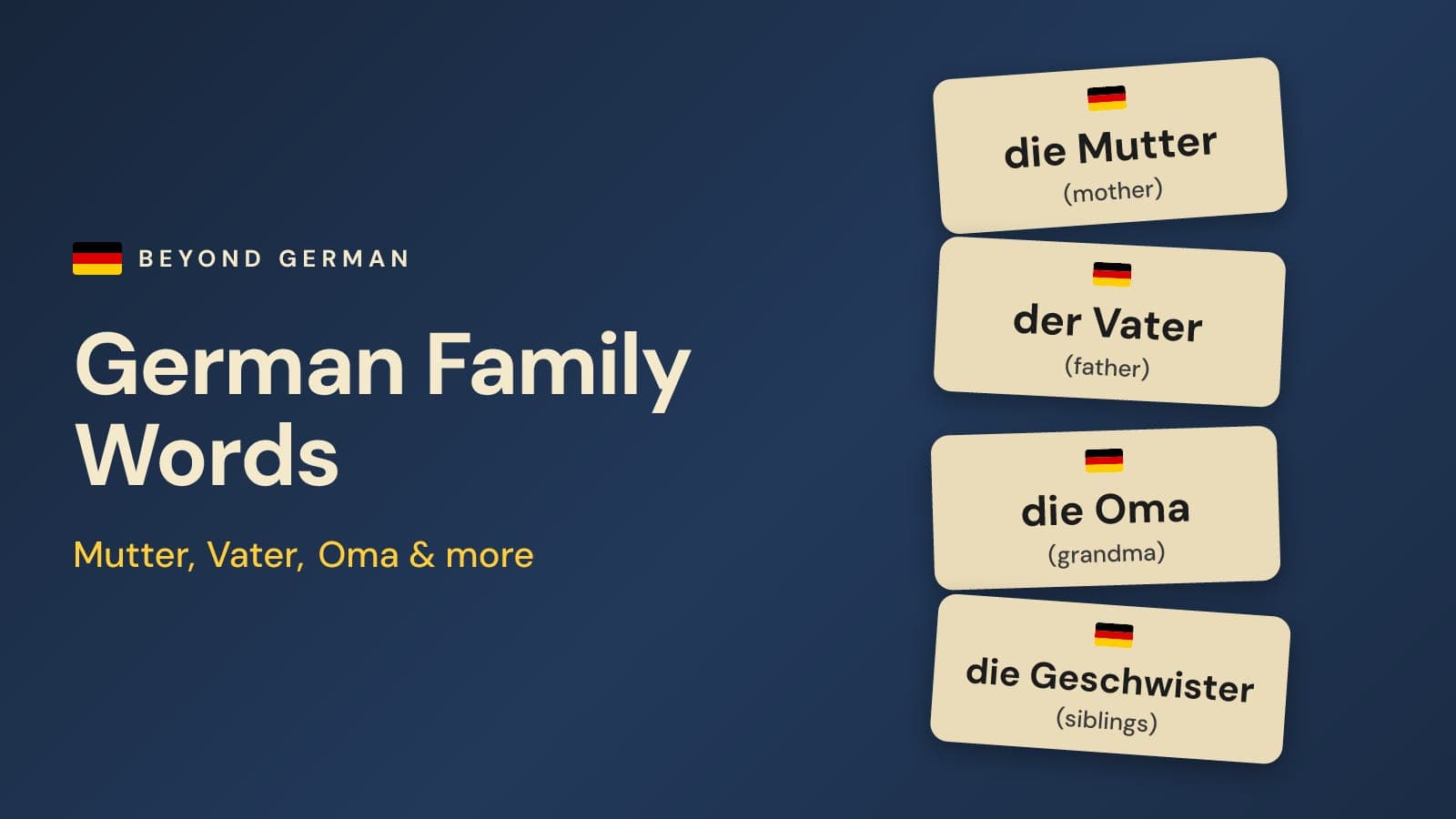
The core family members in German are die Mutter (mother), der Vater (father), die Eltern (parents), der Bruder (brother), die Schwester (sister) and die Geschwister (siblings). Oma means grandma (formally die Großmutter), and Opa means grandpa (der Großvater).
Below you'll find all the words you need to talk about die Familie (the family), from aunts and cousins to in-laws and step-siblings, each with its article and plural. You'll also learn how to say "my mother" correctly, plus ready-to-use sentences about your own family.
Parents, Children and Siblings
Always learn family words with their article and plural. The good news: in this group, the grammatical gender matches the person. Women are die, men are der. The one exception is das Kind. An easy way to remember it: a child can be a boy or a girl, so the word is neuter.
| German | Plural | English |
|---|---|---|
| die Familie | die Familien | family |
| die Mutter | die Mütter | mother |
| der Vater | die Väter | father |
| die Eltern | (plural only) | parents |
| das Kind | die Kinder | child |
| der Sohn | die Söhne | son |
| die Tochter | die Töchter | daughter |
| der Bruder | die Brüder | brother |
| die Schwester | die Schwestern | sister |
| die Geschwister | (plural only) | siblings |
| der Mann | die Männer | husband (also: man) |
| die Frau | die Frauen | wife (also: woman) |
Look at the plurals: Mutter becomes Mütter, Vater becomes Väter, and Bruder, Tochter and Sohn also add an umlaut. Schwester is the regular one: Schwestern. There's no shortcut, so learn each word as a pair: der Vater, die Väter.
Eltern and Geschwister are plural-only words in everyday German, so they always take a plural verb:
- Meine Eltern sind sehr nett. — My parents are very nice.
- Hast du Geschwister? — Do you have any siblings?
Need to talk about just one parent? Say ein Elternteil (a parent), or simply meine Mutter or mein Vater.
For "husband" and "wife", Germans normally say mein Mann and meine Frau. Der Ehemann and die Ehefrau exist, but they sound formal, like something from an official form.
Grandparents and Grandchildren: Oma, Opa and Co.
Oma means grandma and Opa means grandpa. These are the words almost everyone uses in daily life; Großmutter and Großvater are the more formal versions. Notice the pattern: Groß- plus the parent word, just like English "grand-" plus "mother".
| German | Plural | English |
|---|---|---|
| die Großmutter | die Großmütter | grandmother |
| die Oma | die Omas | grandma |
| der Großvater | die Großväter | grandfather |
| der Opa | die Opas | grandpa |
| die Großeltern | (plural only) | grandparents |
| der Enkel | die Enkel | grandson, grandchild |
| die Enkelin | die Enkelinnen | granddaughter |
| das Enkelkind | die Enkelkinder | grandchild |
Going back one more generation? Add Ur-: die Urgroßmutter (informally die Uroma) is your great-grandmother, and der Urenkel is a great-grandson.
- Meine Großeltern wohnen auf dem Land. — My grandparents live in the countryside.
- Meine Oma backt den besten Apfelkuchen. — My grandma bakes the best apple cake.
Extended Family: Aunts, Uncles and Cousins
| German | Plural | English |
|---|---|---|
| der Onkel | die Onkel | uncle |
| die Tante | die Tanten | aunt |
| der Cousin | die Cousins | cousin (male) |
| die Cousine | die Cousinen | cousin (female) |
| der Neffe | die Neffen | nephew |
| die Nichte | die Nichten | niece |
| der/die Verwandte | die Verwandten | relative |
English has one word for "cousin", but German makes you choose: der Cousin for a man, die Cousine for a woman. Both come from French and are pronounced the French way (Cousine sounds like "koo-ZEE-nuh").
Small grammar note: der Neffe adds -n outside the nominative. Ich besuche meinen Neffen. — I'm visiting my nephew.
Just like in English, children often call their parents' close friends Tante (aunt) and Onkel (uncle), even without a family connection. And a Tante-Emma-Laden ("Aunt Emma shop") is a small, old-fashioned corner store.
In-Laws, Step-Family and Half-Siblings
In-laws: the Schwieger- words
To make an in-law, put Schwieger- in front of the basic word. The exceptions are brother-in-law and sister-in-law, which have their own words.
| German | Plural | English |
|---|---|---|
| die Schwiegermutter | die Schwiegermütter | mother-in-law |
| der Schwiegervater | die Schwiegerväter | father-in-law |
| die Schwiegereltern | (plural only) | parents-in-law |
| der Schwiegersohn | die Schwiegersöhne | son-in-law |
| die Schwiegertochter | die Schwiegertöchter | daughter-in-law |
| der Schwager | die Schwäger | brother-in-law |
| die Schwägerin | die Schwägerinnen | sister-in-law |
So your spouse's brother is your Schwager. There's no "Schwiegerbruder".
Step and half family: Stief- and Halb-
These work just like English. Stief- means "step-" (related through a parent's new partner), and Halb- means "half-" (you share one parent).
| German | Plural | English |
|---|---|---|
| der Stiefvater | die Stiefväter | stepfather |
| die Stiefmutter | die Stiefmütter | stepmother |
| der Stiefbruder | die Stiefbrüder | stepbrother |
| die Stiefschwester | die Stiefschwestern | stepsister |
| der Halbbruder | die Halbbrüder | half-brother |
| die Halbschwester | die Halbschwestern | half-sister |
- Mein Halbbruder wohnt bei seinem Vater. — My half-brother lives with his father.
A blended family is often called a Patchworkfamilie.
Mama, Papa, Oma, Opa: Informal vs. Formal
| Formal | Informal | English |
|---|---|---|
| die Mutter | die Mama | mom / mum |
| der Vater | der Papa | dad |
| die Großmutter | die Oma | grandma |
| der Großvater | der Opa | grandpa |
| die Großeltern | Oma und Opa | grandparents |
Culture note: many German adults keep calling their parents Mama and Papa all their lives, and it doesn't sound childish the way "mommy" can in English. You'll also hear Mutti and Vati, which sound a bit old-fashioned today.
- Ich telefoniere jeden Sonntag mit meiner Mama. — I call my mom every Sunday.
When you talk about your own family, Mama, Papa, Oma and Opa often work like names, with no article: Oma kommt morgen. — Grandma is coming tomorrow. In southern Germany and Austria, you'll often hear an article in front: Die Oma kommt morgen.
Use the formal words in official situations and when you ask politely about someone else's family: Wie geht es Ihrer Mutter? — How is your mother? And avoid calling strangers "Oma" or "Opa": it's very casual and can come across as rude.
Possessives: meine Mutter, mein Vater, meine Eltern
To say "my mother" or "my father", use mein. It takes the same endings as ein (and kein in the plural), so its form depends on the noun's gender (our guide to der, die, das explains how to tell) and on its case:
| Gender | Nominative | Accusative | Dative |
|---|---|---|---|
| Masculine | mein Vater | meinen Vater | meinem Vater |
| Feminine | meine Mutter | meine Mutter | meiner Mutter |
| Neuter | mein Kind | mein Kind | meinem Kind |
| Plural | meine Eltern | meine Eltern | meinen Eltern |
- Mein Vater ist Lehrer. — My father is a teacher.
- Meine Eltern wohnen in Hamburg. — My parents live in Hamburg.
- Ich besuche meinen Bruder. — I'm visiting my brother.
- Am Wochenende gehe ich mit meiner Schwester ins Kino. — This weekend I'm going to the movies with my sister.
In the accusative, only the masculine form changes (meinen); the accusative case guide explains why. Prepositions like mit and bei always take the dative, which is why it's mit meiner Schwester. Our guide to German dative prepositions covers the full list.
The other possessives follow the same pattern: dein (your, informal), sein (his), ihr (her, their), unser (our), euer (your, plural) and Ihr (your, formal). Note that euer drops an e when it gets an ending: eure Eltern.
- Wo wohnt deine Familie? — Where does your family live?
- Sein Sohn ist sieben. — His son is seven.
- Ihre Tochter studiert in Wien. — Her daughter is studying in Vienna.
- Unsere Kinder sprechen Deutsch und Englisch. — Our children speak German and English.
Useful Sentences About Your Family
These are the sentences you'll actually need when someone asks about your family:
- Ich habe zwei Geschwister. — I have two siblings.
- Ich habe einen Bruder und eine Schwester. — I have a brother and a sister.
- Ich habe keine Geschwister. Ich bin Einzelkind. — I don't have any siblings. I'm an only child.
- Wie heißt deine Schwester? — What's your sister's name?
- Wie alt ist dein Bruder? — How old is your brother?
- Meine Schwester ist drei Jahre älter als ich. — My sister is three years older than me.
- Haben Sie Kinder? — Do you have children? (formal)
- Ja, wir haben einen Sohn und zwei Töchter. — Yes, we have a son and two daughters.
- Ich bin verheiratet und habe ein Kind. — I'm married and have one child.
- Meine Oma ist 85 Jahre alt. — My grandma is 85 years old.
- Wir sind eine große Familie. — We're a big family.
To talk about ages, you'll need German numbers 1–100 (85 is fünfundachtzig). And to ask the questions yourself, brush up on German question words like wer, wie and wo.
Common Mistakes With Family Words
1. Forgetting the accusative after haben
Wrong: Ich habe ein Bruder. Right: Ich habe einen Bruder.
Haben takes the accusative, so masculine ein becomes einen. Feminine and neuter don't change: eine Schwester, ein Kind.
2. Using the wrong possessive
Wrong: mein Mutter. Right: meine Mutter.
Mutter is feminine, so it needs meine.
3. Treating Eltern as singular
Wrong: Meine Eltern ist nett. Right: Meine Eltern sind nett.
Eltern is always plural, so the verb is too.
4. Forgetting the umlaut in the plural
Wrong: zwei Bruder, zwei Tochters. Right: zwei Brüder, zwei Töchter.
Learn every family word together with its plural, umlaut included.
5. Calling a female cousin "Cousin"
Wrong: Sie ist mein Cousin. Right: Sie ist meine Cousine.
Cousin is only for men; for women, use Cousine.
Practice
Fill in the gaps, then check your answers below.
- Ich habe ___ Bruder. (ein)
- ___ Mutter heißt Sabine. (mein)
- Ich fahre mit ___ Oma nach Italien. (mein)
- eine Schwester, zwei ___
- brother-in-law = der ___
- Hast du ___? (siblings)
Answers:
- Ich habe einen Bruder.
- Meine Mutter heißt Sabine.
- Ich fahre mit meiner Oma nach Italien.
- zwei Schwestern
- der Schwager
- Hast du Geschwister?
Ready for more? Test yourself with the A1 German quizzes and review the main plural patterns on our German plurals page. Then describe your own family in five sentences, out loud.
Keep learning:
FAQ
What does "Oma" mean in German?
Oma means "grandma". It's the everyday word for die Großmutter (grandmother), used by children and adults alike. The male version is Opa (grandpa), and the plural is die Omas.
How do you say "grandmother" in German?
The formal word is die Großmutter (plural: die Großmütter), and the informal word is die Oma. Grandfather is der Großvater or der Opa, and grandparents are die Großeltern.
What is the German word for "siblings"?
Die Geschwister. It covers brothers and sisters and is plural in everyday use: Ich habe drei Geschwister. — I have three siblings.
Is "Eltern" singular or plural?
Always plural: Meine Eltern sind… For one parent, say ein Elternteil or just name the person: meine Mutter, mein Vater.
How do you say "cousin" in German?
Der Cousin for a male cousin and die Cousine for a female cousin. The plurals are die Cousins and die Cousinen.
Level Up Your German
Join 1,000+ learners getting weekly tips, grammar shortcuts, and cultural insights.
Share this article
Continue Reading
Common German Mistakes English Speakers Make (+ False Friends)
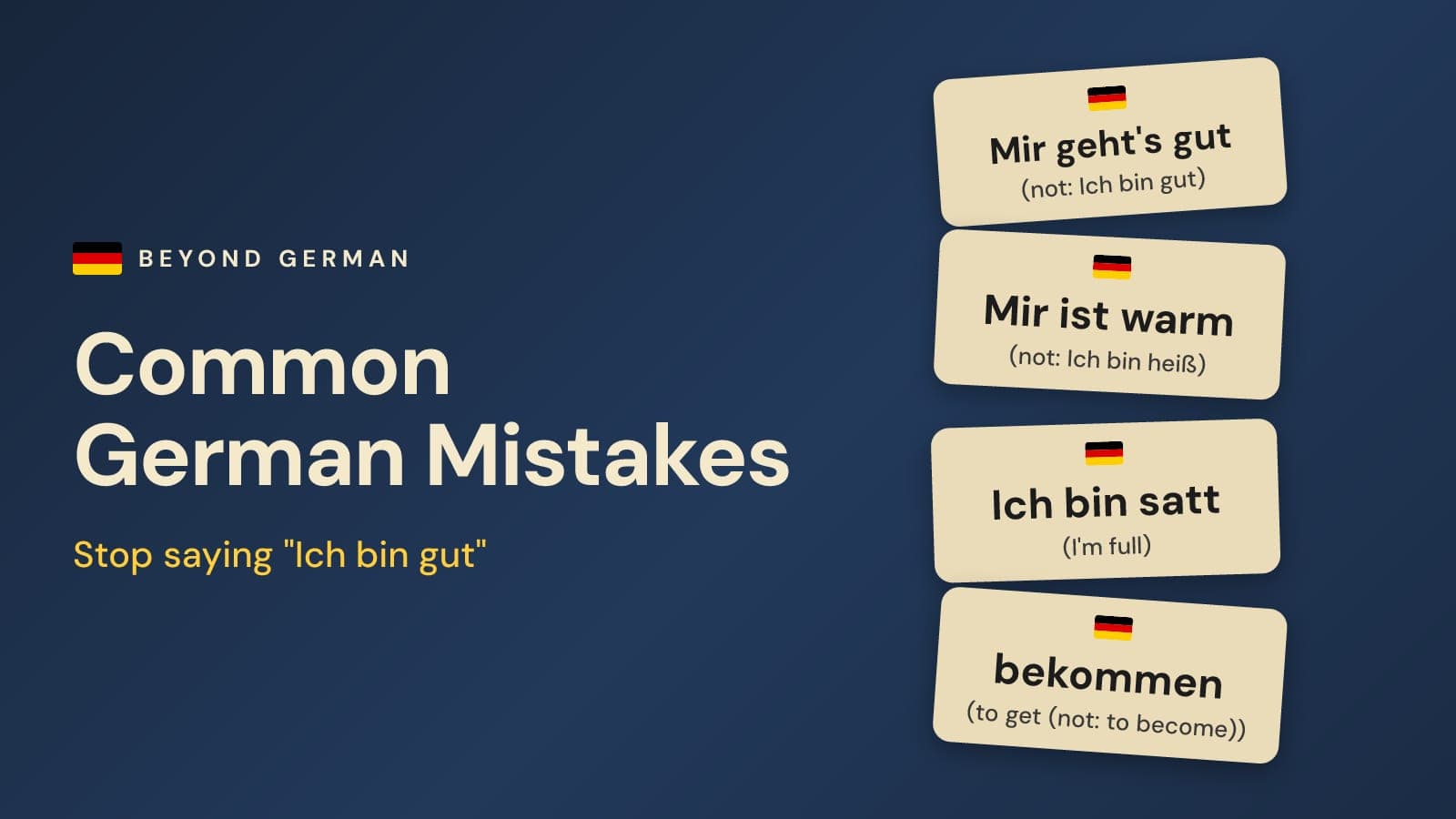
Why 'Ich bin heiß' gets laughs and 'Ich will' doesn't mean 'I will': 15 common German mistakes English speakers make, plus the false friends to watch out for.
Days of the Week in German, Months and How to Say the Date
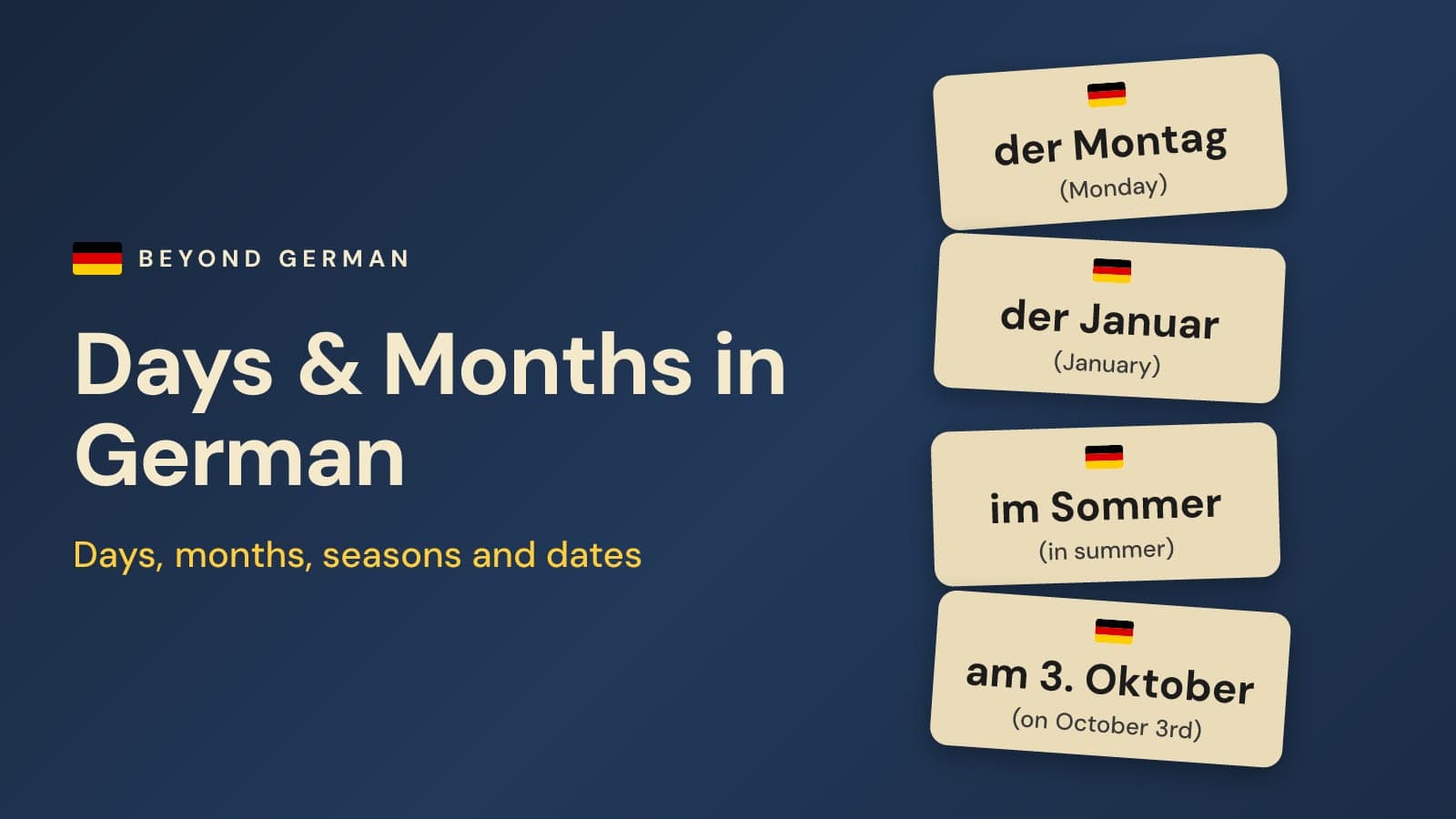
Learn the days of the week and months in German with articles, abbreviations and pronunciation, plus seasons, dates like am 3. Oktober, years and holidays.
Telling Time in German: What Time Is It? (Halb Acht Explained)
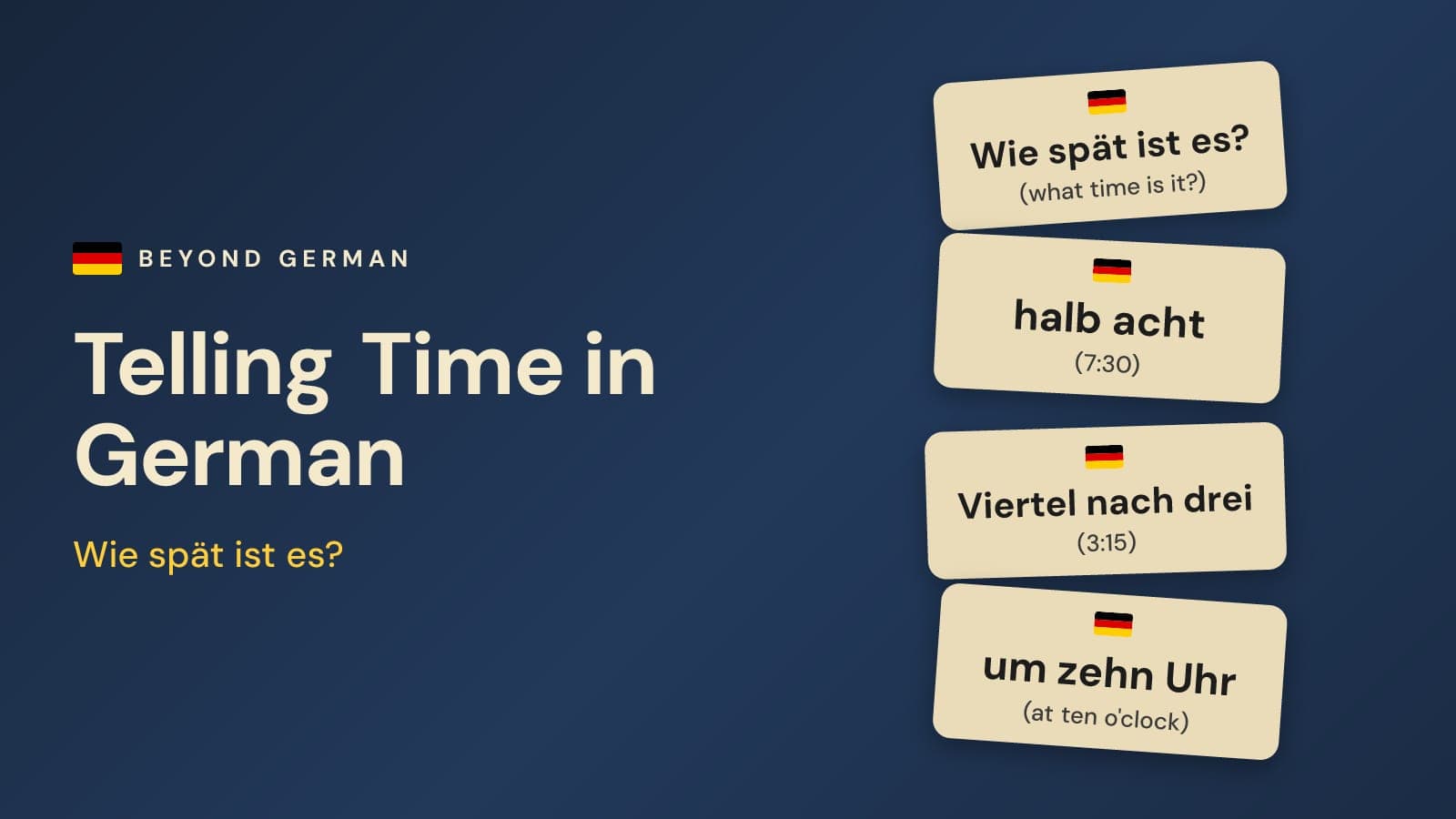
Learn how to tell time in German: ask Wie spät ist es?, use the 24-hour clock, master Viertel nach and Viertel vor, and see why halb acht means 7:30.