
Anmeldung in Germany: German Phrases for the Bürgeramt
 Beyond German Team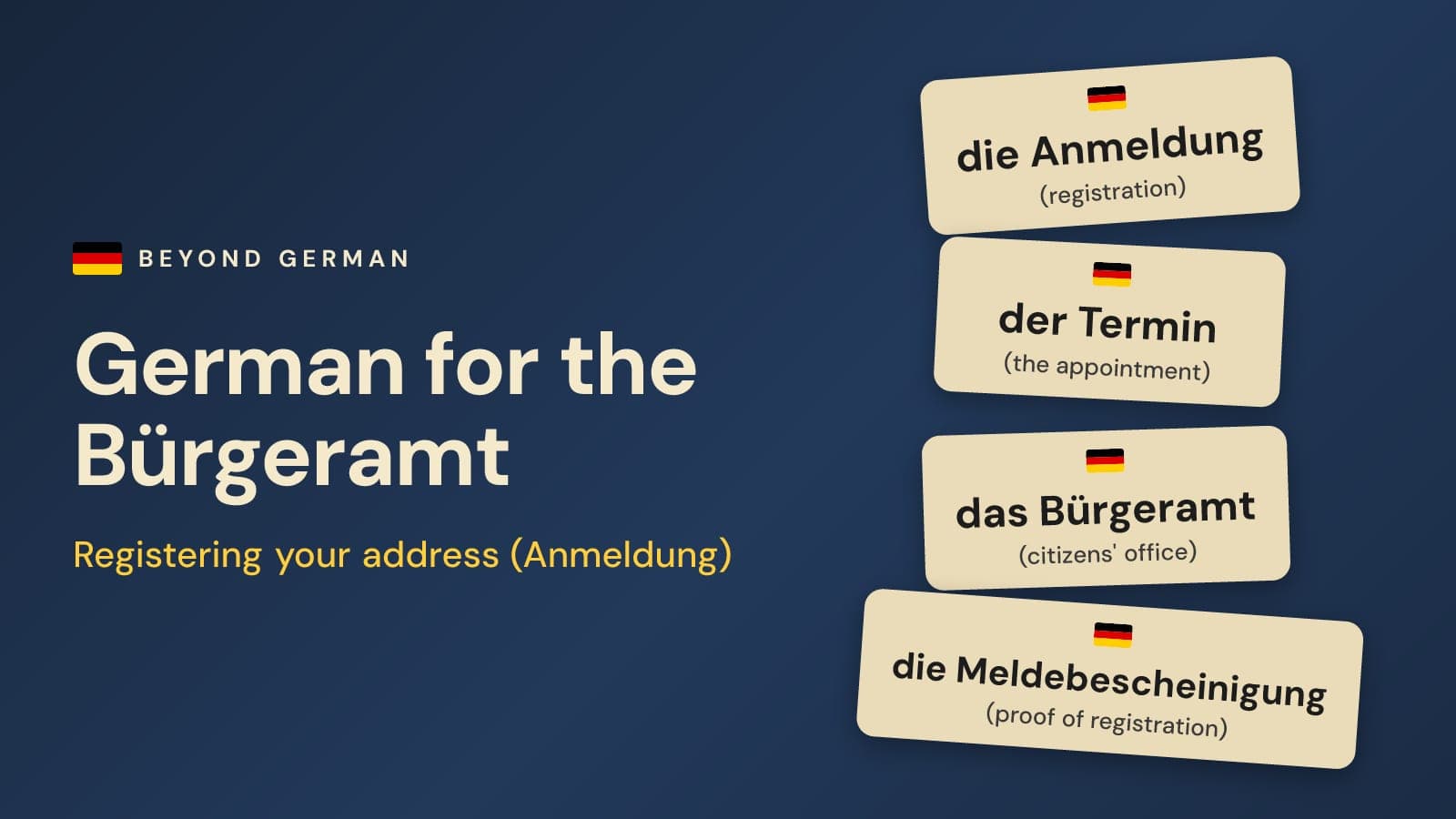
To register your address in Germany, you book an appointment at your local Bürgeramt (citizens' office), bring your passport or ID card, a confirmation from your landlord (the Wohnungsgeberbestätigung) and the registration form, and say: Ich möchte mich anmelden. — I'd like to register. This registration is called the Anmeldung, and you generally have to do it within two weeks of moving in.
The appointment is short, but it happens in German. Below are the documents, the key vocabulary with articles, the phrases for the counter, a sample dialogue and what comes next.
What Is the Anmeldung?
Die Anmeldung is the registration of your address with the local authorities. Everyone who moves into a home in Germany has to register: Germans, EU citizens and non-EU citizens alike. The rule comes from the Federal Registration Act (Bundesmeldegesetz, § 17): you generally have two weeks from the day you move in. Registering is free.
The office has different names in different cities, but they all handle the Anmeldung:
- das Bürgeramt — citizens' office (Berlin and many other cities)
- das Einwohnermeldeamt — residents' registration office (the traditional name)
- das Bürgerbüro — citizens' office (common in many cities)
- das Rathaus — town hall (in small towns)
The official term is die Meldebehörde (registration authority). Notice that it's the last part of each compound that decides the gender: das Amt, das Büro, das Haus, but die Behörde.
Documents for the Anmeldung
| Document | German | Good to know |
|---|---|---|
| ID card or passport | der Personalausweis / der Reisepass | Bring the original. Non-EU citizens bring their passport (with visa, if you have one). |
| Landlord's confirmation | die Wohnungsgeberbestätigung | Filled in and signed by your landlord, or by the main tenant if you sublet. |
| Registration form | das Anmeldeformular | Usually on your city's website: fill it in at home and sign it. |
| Certificates for family members | die Heiratsurkunde, die Geburtsurkunde | Only if you register your spouse or children. Ask whether you need a translation. |
Your rental contract (der Mietvertrag) does not replace the Wohnungsgeberbestätigung. If your landlord hasn't given you one, ask for it:
Ich brauche noch die Wohnungsgeberbestätigung für die Anmeldung. — I still need the landlord's confirmation for my registration.
Words You'll See on the Form
- der Familienname / der Vorname — surname / first name
- das Geburtsdatum / der Geburtsort — date / place of birth
- die Staatsangehörigkeit — nationality
- der Familienstand — marital status: ledig (single), verheiratet (married), geschieden (divorced), verwitwet (widowed)
- das Einzugsdatum — move-in date
- die bisherige Wohnung — previous address. Coming from abroad? Look for Zuzug aus dem Ausland (moving from abroad).
- die Religion — religious affiliation. This decides whether church tax (die Kirchensteuer) is deducted from your salary, so answer accurately.
Booking an Appointment: Termin buchen
In most cities, you book einen Termin (an appointment) online on the city's website. Search for your city's name plus Anmeldung Termin; in Berlin, for example, the service is called Anmeldung einer Wohnung. In smaller towns you can often just walk in during opening hours (die Öffnungszeiten), and in many regions you can also book by calling 115, the public-service hotline.
Words you'll see on the booking page:
- Termin buchen / Termin vereinbaren — book an appointment
- freie Termine — available appointments
- der Standort — location (which office)
- die Terminbestätigung — appointment confirmation
- Termin absagen — cancel an appointment
- Leider sind keine Termine frei. — Unfortunately, no appointments are available.
If the earliest free appointment is more than two weeks away, book it anyway and keep the confirmation email as proof that you tried. Cancelled slots come back, so check again over the next few days.
On the phone, say: Ich möchte einen Termin für eine Anmeldung vereinbaren. — I'd like to make an appointment to register my address.
Some cities now offer online registration, but only if you're already registered in Germany and have an ID card with the online function. After moving from abroad, you'll register in person.
Key Vocabulary for the Bürgeramt
| German | English | Good to know |
|---|---|---|
| die Anmeldung | registration | sich anmelden = to register (yourself) |
| die Meldebescheinigung | certificate of registration | The paper you get at the appointment is officially the Meldebestätigung, but most people call it the Meldebescheinigung. |
| der Wohnsitz | (place of) residence | The address where you're registered |
| der Hauptwohnsitz | main residence | Where you mainly live; a second home is der Nebenwohnsitz |
| die Steuer-ID | tax ID | Comes by post after your first registration (die Steuer = tax) |
| die Abmeldung | deregistration | When you leave Germany for good |
| die Ummeldung | change of address | When you move within Germany: you simply register at the new address |
| der Vermieter / die Vermieterin | landlord / landlady | Gives you the Wohnungsgeberbestätigung |
| die Unterschrift | signature | unterschreiben = to sign |
German Phrases for the Bürgeramt
What You'll Say
- Ich habe einen Termin um zehn Uhr dreißig. — I have an appointment at 10:30.
- Ich möchte mich anmelden. — I'd like to register (my address).
- Ich bin gerade umgezogen. — I've just moved.
- Ich bin gerade aus den USA nach Deutschland gezogen. — I've just moved to Germany from the US.
- Ich wohne in einer WG. — I live in a shared flat.
- Ich habe das Formular schon ausgefüllt. — I've already filled in the form.
- Wo muss ich unterschreiben? — Where do I need to sign?
- Brauche ich noch etwas? — Do I need anything else?
- Könnten Sie das bitte langsamer sagen? — Could you say that more slowly, please?
- Wann bekomme ich die Steuer-ID? — When will I get my tax ID?
For the time, zehn Uhr dreißig and halb elf both work; our guide to telling time in German explains why halb elf means 10:30.
What You'll Hear
- Was kann ich für Sie tun? — What can I do for you?
- Ihren Ausweis, bitte. — Your ID, please.
- Haben Sie die Wohnungsgeberbestätigung dabei? — Do you have the landlord's confirmation with you?
- Wann sind Sie eingezogen? — When did you move in?
- Ist das Ihre einzige Wohnung? — Is this your only home?
- Sind Sie Mitglied einer Kirche? — Are you a member of a church?
- Wie schreibt man das? — How do you spell that?
- Unterschreiben Sie bitte hier. — Please sign here.
Always use Sie with staff. If you get stuck, the survival lines from our essential German phrases for beginners will rescue you, especially Können Sie langsamer sprechen?
Sample Dialogue at the Bürgeramt
Here's how a typical appointment might go. Die Mitarbeiterin is the clerk.
| German | English |
|---|---|
| Mitarbeiterin: Guten Morgen! Was kann ich für Sie tun? | Good morning! What can I do for you? |
| Sie: Guten Morgen. Ich habe einen Termin um neun Uhr vierzig. Ich möchte mich anmelden. | Good morning. I have an appointment at 9:40. I'd like to register. |
| Mitarbeiterin: Gut. Ihren Pass und die Wohnungsgeberbestätigung, bitte. | Fine. Your passport and the landlord's confirmation, please. |
| Sie: Bitte schön. Das Formular habe ich schon ausgefüllt. | Here you are. I've already filled in the form. |
| Mitarbeiterin: Danke. Wann sind Sie eingezogen? | Thank you. When did you move in? |
| Sie: Am ersten Oktober. Ich bin gerade aus Kanada nach Köln gezogen. | On October 1st. I've just moved to Cologne from Canada. |
| Mitarbeiterin: Ist das Ihre einzige Wohnung in Deutschland? | Is this your only home in Germany? |
| Sie: Ja. | Yes. |
| Mitarbeiterin: Sie haben das Formular noch nicht unterschrieben. Unterschreiben Sie bitte hier unten, neben dem Datum. | You haven't signed the form yet. Please sign down here, next to the date. |
| Sie: Entschuldigung, könnten Sie das bitte langsamer sagen? | Sorry, could you say that more slowly, please? |
| Mitarbeiterin: Natürlich. Bitte hier unterschreiben. | Of course. Please sign here. |
| Sie: Ach so. Brauche ich noch etwas? | Oh, I see. Do I need anything else? |
| Mitarbeiterin: Nein, das ist alles. Hier ist Ihre Meldebestätigung. Die Steuer-ID bekommen Sie in ein paar Wochen per Post. | No, that's everything. Here's your proof of registration. You'll get your tax ID by post in a few weeks. |
| Sie: Vielen Dank! Auf Wiedersehen. | Thank you very much! Goodbye. |
What Happens After the Anmeldung
- You get your proof of registration right away. Keep the Meldebestätigung (or Meldebescheinigung, as most people say) safe and make copies: you'll need it again and again.
- Your Steuer-ID arrives by post. The Federal Central Tax Office (das Bundeszentralamt für Steuern) usually sends it within a few weeks. Your employer needs it for your payroll, so put your name on your mailbox (der Briefkasten), or the letter may never reach you.
- You can open a bank account. Many banks ask for your Meldebescheinigung before they open a Girokonto (current account). If you came on a student visa, you need this account for the monthly payouts from your blocked account, as our German student visa guide explains.
- A letter about the Rundfunkbeitrag arrives. This is the public broadcasting fee, charged per apartment, not per person. The registration office passes on your details, so the letter comes automatically; many Germans still call it die GEZ. If someone in your flat already pays, you don't pay twice: you reply with their contribution number (die Beitragsnummer).
If you need a residence permit, the immigration office (die Ausländerbehörde) will usually want to see your registration too.
Tips for a Smooth Appointment
- Be on time. Arrive a few minutes early: if you're late, you may lose your appointment.
- Bring originals of every document, not copies.
- Practice your personal details out loud. Dates use ordinal numbers: Ich bin am 14. März 1998 geboren. — I was born on March 14, 1998 (say: am vierzehnten März neunzehnhundertachtundneunzig). Our guides to German numbers and how to say the date in German cover both.
- Be ready to spell your name. Names from other languages are easy to misspell, so learn to spell yours with the German alphabet.
- Bring a German speaker if you're nervous. The official language at German offices is German, and staff don't have to speak English. Many do, but don't count on it.
- Remember the Abmeldung. When you leave Germany for good, deregister, again generally within two weeks of moving out.
Common Mistakes
1. Saying "Ich möchte anmelden"
To register yourself, you need the reflexive pronoun: Ich möchte mich anmelden. Without mich, the verb needs another object: you can ein Auto anmelden (register a car), but you register yourself with mich. See our guide to German reflexive verbs.
2. Saying "Ich habe mich umgezogen"
Sich umziehen means to change clothes. To say you moved house, drop the mich and use sein: Ich bin umgezogen. — I've moved. Verbs of movement take sein in the perfect tense; our guide to haben or sein in the perfect tense explains the rule.
3. Using the wrong time preposition
Clock times take um, days and dates take am: Ich habe am Montag um 10 Uhr einen Termin. — I have an appointment on Monday at 10. More in our guide to German time prepositions.
4. Mixing up Steuer-ID and Steuernummer
Your Steuer-ID comes after the Anmeldung and stays the same for life. The Steuernummer is a different number from your local tax office (das Finanzamt), for example if you're self-employed. Employers ask for the Steuer-ID.
Practice: At the Counter
Say these in German, out loud, before you check the answers:
- You want to register your address.
- You have an appointment at 11:30.
- You've just moved.
- The clerk is speaking too fast.
- You want to know if you need anything else.
Answers: 1. Ich möchte mich anmelden. 2. Ich habe einen Termin um elf Uhr dreißig (or: um halb zwölf). 3. Ich bin gerade umgezogen. 4. Könnten Sie das bitte langsamer sagen? 5. Brauche ich noch etwas?
Most Bürgeramt verbs are separable, so they split in the present tense: Ich melde mich an. — I'm registering. Ich fülle das Formular aus. — I'm filling in the form. Our guide to German separable verbs explains the pattern.
Finally, rehearse your name, nationality and address with our guide on how to introduce yourself in German, and fill in the Anmeldeformular at home as a dress rehearsal.
FAQ
How long do I have to register my address in Germany?
Generally within two weeks of moving in (§ 17 Bundesmeldegesetz). If no appointment is free in time, book the earliest one and keep the confirmation.
Do I need to speak German at the Bürgeramt?
The official language is German, and staff aren't required to speak English. Many do, but learn the key phrases above or bring a German-speaking friend.
Is the Anmeldung free?
Yes. Registering and the confirmation you get at the appointment are free. Some extra certificates you request later can cost a small fee.
What's the difference between Anmeldung, Ummeldung and Abmeldung?
Anmeldung is registering a new address, Ummeldung is the everyday word for registering a move within Germany, and Abmeldung is deregistering when you leave the country.
Level Up Your German
Join 1,000+ learners getting weekly tips, grammar shortcuts, and cultural insights.
Share this article
Continue Reading

German at the Doctor: Phrases for Appointments & Symptoms
The German you need at the doctor and pharmacy: making an appointment, describing symptoms and pain, understanding the doctor, sick notes and emergency numbers.
How to Tip in Germany: Paying the Bill, Stimmt so & More
How to ask for the bill in German, answer Zusammen oder getrennt?, tip the German way with Stimmt so, and pay by card or cash in restaurants, taxis and beyond.
The German Student Visa Guide (2026): Blocked Accounts & Requirements Explained
Applying for a German Student Visa can be overwhelming. We break down the exact requirements for 2026, including blocked amount (€11,904), proof of funds, and the step-by-step application process.