Goethe A1 Word List: What's on It and How to Learn It
 Beyond German Team
The Goethe A1 word list (in German, the Wortliste) is the official vocabulary list behind the Goethe-Zertifikat A1: Start Deutsch 1 exam. It has about 650 words, and the Goethe-Institut says you should understand all of them and be able to use about half. You can download it free as a PDF, but it's written entirely in German and sorted alphabetically, which makes it a reference rather than something you can learn from.
This guide explains what's on the list, how to read it, and how to actually learn it. You'll also get a free extract of 40 words from the list, sorted by real-life situation and translated into English.
A quick note: Beyond German isn't connected to the Goethe-Institut. We built our A1 materials around its public word list because that's the vocabulary the A1 exam expects.
What Is the Goethe A1 Word List?
The word list is part of the official description of the Start Deutsch 1 exam, the Goethe-Institut's test for level A1 of the Common European Framework (CEFR). A1 is the first of six levels: you can introduce yourself, ask simple questions and handle everyday moments like buying bread or registering your address.
It matters for more than the exam itself. According to the list's own foreword, German embassies and immigration offices accept the Start Deutsch 1 certificate as proof of basic German when you join your spouse in Germany. So for many people, these 650 words are the first real step of moving here.
A few facts about how the list was made:
- It's built on everyday communication, not word frequency. The words come from four areas of life: private life, work, education and public life.
- "Knowing" a word has two levels. You should recognise all of the words when you hear or read them, and be able to use roughly half of them yourself.
- Some words are there for the exam itself, like ankreuzen (to tick a box) and ergänzen (to fill in, to complete), because the tasks use them.
- Female forms are included without being listed. If the list says der Lehrer (teacher), you're also expected to know die Lehrerin.
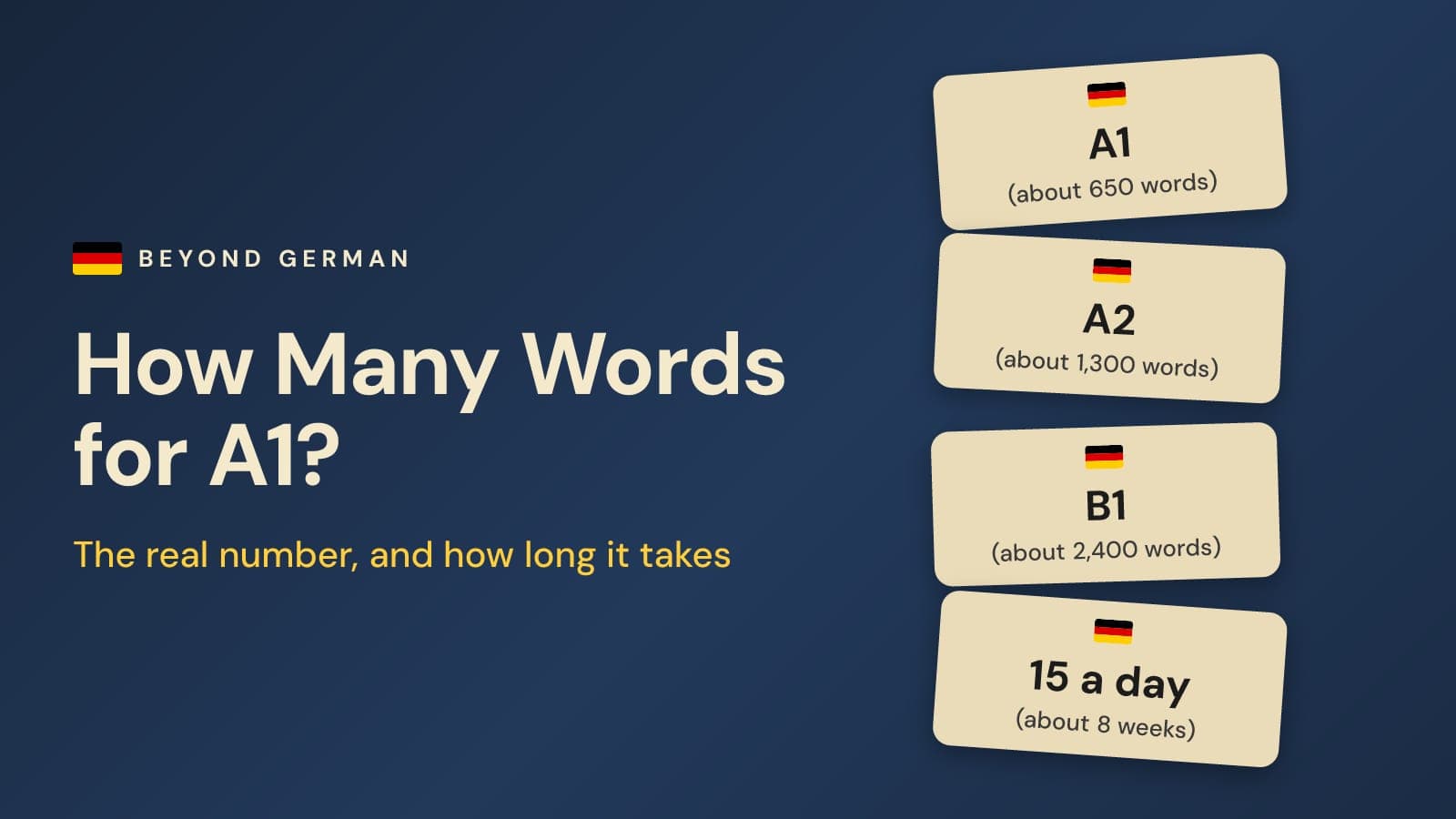
Wondering whether 650 words is a lot or a little? We answer that in detail in how many words you need for A1 German.
How the List Is Organised
The official PDF has three parts: a list of topics, 13 word groups, and the alphabetical word list itself.
1. The topics
First comes a list of the topics A1 learners should be able to talk about. Here they are in English, with typical words for each one:
| Topic | What it covers | Typical words |
|---|---|---|
| Person | name, address, age, family, nationality | der Name, die Adresse, verheiratet |
| Wohnen (living) | the flat, rooms, furniture, rent, moving | die Wohnung, die Miete, der Schrank |
| Umwelt (environment) | plants, animals, weather | das Wetter, der Hund, die Blume |
| Reisen und Verkehr (travel) | transport, trips, hotels, luggage | der Zug, das Hotel, der Koffer |
| Essen und Trinken (food and drink) | food, meals, drinks, cafés, restaurants | das Brot, das Frühstück, die Speisekarte |
| Einkaufen (shopping) | shops, prices, paying, clothes | das Geschäft, die Kasse, die Jacke |
| Dienstleistungen (services) | post, phone, banks, police | die Post, das Konto, die Polizei |
| Lernen (learning) | childcare, school, language courses | der Kindergarten, der Kurs, die Prüfung |
| Arbeit und Beruf (work) | the workplace, holidays | die Arbeit, der Kollege, der Urlaub |
| Freizeit (free time) | interests, sport, TV, the internet, reading | der Sport, das Kino, die Zeitung |
2. The 13 word groups
Before the alphabetical part, the list collects 13 groups of words that belong together: numbers, the date, telling the time, units of time, the days of the week, times of day, the months, the seasons, money, weights and measures, countries and nationalities, colours and the points of the compass.
These groups are some of the most useful words on the whole list, and we already have full guides for several of them: German numbers, days of the week and months, telling the time and colours in German.
3. The alphabetical list
The main part runs from ab to zwischen. Each entry has the word, its article and often a short plural ending, followed by one or more German example sentences. Some entries have smaller, indented words under them that you can work out from the main word, like abfahren (to depart) and, under it, die Abfahrt (the departure). Those indented words aren't part of the 650 count, so the real number of words you meet is a bit higher.
How to Read an Entry: Articles and Plural Endings
The list saves space by writing plurals as short notes after a comma. The notation isn't always consistent, but once you know the idea, it's quick to read. Here are real examples from the list:
| On the list | Means | Plural |
|---|---|---|
| der Tag, -e | add -e | die Tage |
| die Zeitung, -en | add -en | die Zeitungen |
| das Apartment, -s | add -s | die Apartments |
| der Apfel, -Ä | umlaut, no ending | die Äpfel |
| der Zug, -ü, e | umlaut plus -e | die Züge |
| das Zimmer + a dash | no change | die Zimmer |
Two things to keep in mind. In the nominative, the plural article is always die, whatever the singular article is. And the list only gives plurals where they matter at A1, so some nouns have none. If you want the patterns behind these endings, read our guide to German plural rules.
Why the Official List Is Hard to Learn From
The Goethe-Institut is honest about this: its foreword says the list is meant as information and a reference, and is less suited to practising and remembering vocabulary. Here's why most learners get stuck when they try to study it directly:
- It's alphabetical. Abholen (to pick up) sits right above der Absender (the sender), and der Arm (arm) next to der Arbeitsplatz (workplace). Your memory works by situations, not by the alphabet.
- There's no English. The example sentences show how a word is used, but if you don't understand the sentence, it doesn't help.
- There's no audio. You can't learn to recognise das Brötchen in a busy bakery from a PDF.
- Plurals and verb forms are incomplete. You still need to look up that fahren becomes er fährt and ist gefahren.
That doesn't make the list useless. It's the best checklist there is for A1. You just need a better way to learn what's on it.
A Free Extract: 40 Words From the List, by Situation
Here are 40 words from the Goethe A1 list, regrouped by the moment you'll actually need them and translated into English. Nouns come with their article and plural, and verbs with the form you'll hear most.
Hello and first conversations
| German | English |
|---|---|
| Guten Tag! | Hello! (polite, during the day) |
| Tschüss! | Bye! |
| Entschuldigung! | Excuse me! / Sorry! |
| Wie bitte? | Sorry? / Pardon? |
| der Name, die Namen | name |
| das Land, die Länder | country |
| die Sprache, die Sprachen | language |
| wohnen (ich wohne) | to live (somewhere) |
- Guten Tag, ich habe einen Termin. Hello, I have an appointment.
- Wie bitte? Können Sie das noch einmal sagen? Sorry? Could you say that again?
At the bakery and café
| German | English |
|---|---|
| die Bäckerei, die Bäckereien | bakery |
| das Brötchen, die Brötchen | bread roll |
| das Brot, die Brote | bread, loaf |
| der Kaffee | coffee |
| die Milch | milk |
| die Flasche, die Flaschen | bottle |
| die Rechnung, die Rechnungen | bill, check |
| kosten (es kostet) | to cost |
- Vier Brötchen, bitte. Four rolls, please.
- Was kostet der Kaffee? How much is the coffee?
Getting around town
| German | English |
|---|---|
| der Bahnhof, die Bahnhöfe | (train) station |
| die Haltestelle, die Haltestellen | bus or tram stop |
| die Straße, die Straßen | street, road |
| der Zug, die Züge | train |
| die Fahrkarte, die Fahrkarten | ticket (bus, train) |
| das Gleis, die Gleise | platform (number) |
| abfahren (er fährt ab) | to depart, to leave |
| aussteigen (wir steigen aus) | to get off (bus, train) |
- Wann fährt der Zug nach Köln ab? When does the train to Cologne leave?
- Wir steigen am Alexanderplatz aus. We get off at Alexanderplatz.
Your flat
| German | English |
|---|---|
| die Wohnung, die Wohnungen | flat, apartment |
| das Zimmer, die Zimmer | room |
| die Küche, die Küchen | kitchen |
| das Bad, die Bäder | bathroom |
| der Schlüssel, die Schlüssel | key |
| die Miete, die Mieten | rent |
| der Vermieter, die Vermieter | landlord |
| mieten (wir mieten) | to rent |
- Wie viele Zimmer hat die Wohnung? How many rooms does the flat have?
- Ich finde meinen Schlüssel nicht. I can't find my key.
Forms and offices
| German | English |
|---|---|
| das Formular, die Formulare | form |
| ausfüllen (Sie füllen aus) | to fill in |
| der Vorname, die Vornamen | first name |
| geboren | born |
| der Familienstand | marital status |
| die Unterschrift, die Unterschriften | signature |
| der Pass, die Pässe | passport |
| die Anmeldung, die Anmeldungen | registration |
- Bitte füllen Sie dieses Formular aus. Please fill in this form.
- Wann sind Sie geboren? When were you born?
These last words are exactly what you'll need on your first visit to the Bürgeramt. Our guide to German for the Anmeldung walks you through that appointment step by step.
How to Learn the Goethe A1 Word List
Going through the PDF from A to Z is the slowest way to learn it. This is what works better:
- Regroup the words by situation, like the extract above. Ten words you need at the bakery are easier to remember than ten words that start with B.
- Learn every noun with its article and plural, as one unit: der Bahnhof, die Bahnhöfe. Half of the A1 list is nouns, so this habit pays off fast. Our list of 100 common German nouns with articles and plurals is a good place to practise it, and der, die, das rules help you guess the rest.
- Learn verbs with their key forms: fahren, er fährt, ist gefahren.
- Put each word in a sentence you could say in your own life, and say it out loud.
- Listen to every word, so you recognise it in real speech, not just on paper.
- Review on a schedule: the next day, a few days later, a week later. Our guide on how to memorize German vocabulary shows a simple 20-minute routine.
At 15 new words a day plus review, you can cover the whole list in about two months.
The Whole List, Sorted and With English: the A1 Word Kit
If you'd rather not regroup and translate 650 words yourself, that's exactly what we did in the A1 Word Kit. It covers every word on the Goethe A1 list plus a few everyday words you need from day one in Germany (like Pfand, the bottle deposit): 787 words in 26 real-life chapters, from the bakery and the Bürgeramt to the doctor's surgery. Every word has its article and plural or verb forms, two example sentences with English, and audio in a natural German AI voice. Flashcards in your account bring each word back before you forget it.
Want to try it first? The free A1 Word Kit sample has 100 of those words in four chapters, with all the audio. You only need your name and email.
Common Mistakes With the A1 Word List
- Learning nouns without their article. "Bahnhof = station" isn't enough. You need der to say zum Bahnhof or am Bahnhof correctly.
- Skipping the word groups. Numbers, times and dates come up in every part of the exam, especially in listening.
- Treating "recognise" and "use" the same. You don't need to produce all 650 words. Make sure you can say the everyday half and recognise the rest.
- Only reading, never listening. The listening part of the exam is where unknown sounds hurt most.
- Cramming the night before. Words you learn in one go fade within days. Little and often beats a long session.
Practice: Test Yourself
Cover the right-hand column of the tables above and say each German word with its article. Then try these:
- How do you say the bill, please? Die Rechnung, bitte!
- What's the plural of der Zug? die Züge
- What does aussteigen mean? to get off (a bus or train)
For a broader check, take our A1 German quiz or the free German level test.
FAQ
Is the Goethe A1 word list free?
Yes. The Goethe-Institut publishes the Start Deutsch 1 word list as a free PDF. It's in German only, with German example sentences and no translations.
How many words are on the Goethe A1 word list?
About 650 counted entries. The indented extra words and the 13 word groups (numbers, months and so on) come on top, so the total you actually meet is somewhere between 750 and 800. Many of those extras follow directly from a word you already know.
Do I need to know every word to pass the A1 exam?
You should understand all of them when you read or hear them, but you only need to use about half actively. Exam texts can also contain words that aren't on the list, as long as you don't need them to answer the question.
Is there an English version of the Goethe A1 word list?
Not an official one. The A1 Word Kit covers the whole list with English translations, example sentences and audio, and the free sample lets you try 100 of the words first.
New from Beyond German
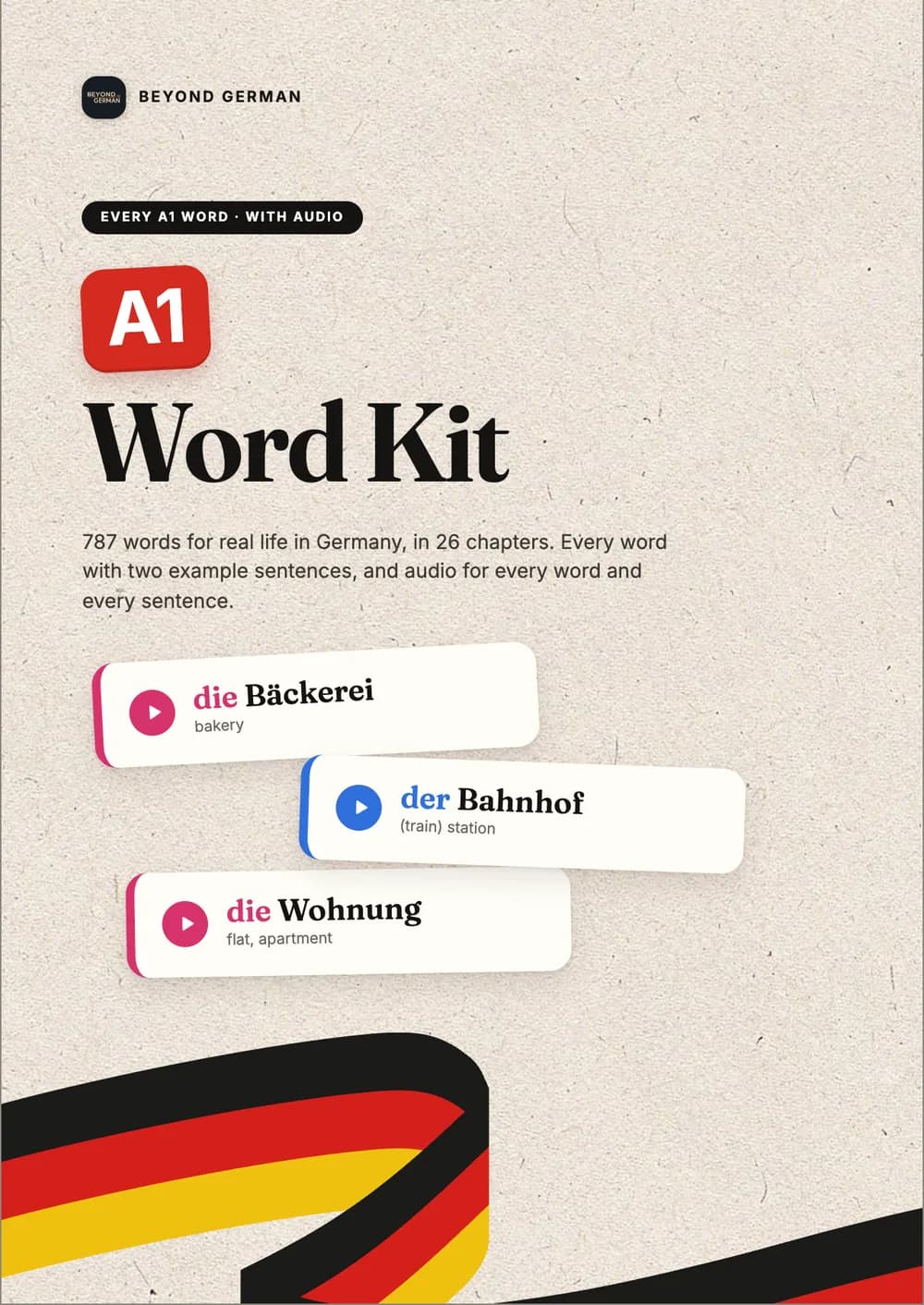
Learn every A1 word, with audio
The A1 Word Kit: 787 words sorted by real life in Germany, two example sentences each, and flashcards that remember for you.
See the kit · launch price €29Level Up Your German
Join 1,000+ learners getting weekly tips, grammar shortcuts, and cultural insights.
Share this article
Continue Reading
How to Memorize German Vocabulary So It Actually Sticks
Seven habits that make German words stick: learn by situation, with articles, in sentences and out loud, then test yourself and review on a schedule.
Common German Nouns With Articles and Plurals: 100 A1 Words
100 common German nouns for A1 with der, die or das, the plural and English, sorted by real life: home, food, town, work, the doctor's and the Bürgeramt.
How Many Words Do You Need for A1 German?
About 650 words for A1, 1,300 for A2 and 2,400 for B1. What an A1 vocabulary really looks like, which words to learn first and how long it takes.