
Animals in German: Names, Plurals, Sounds and Idioms
 Beyond German Team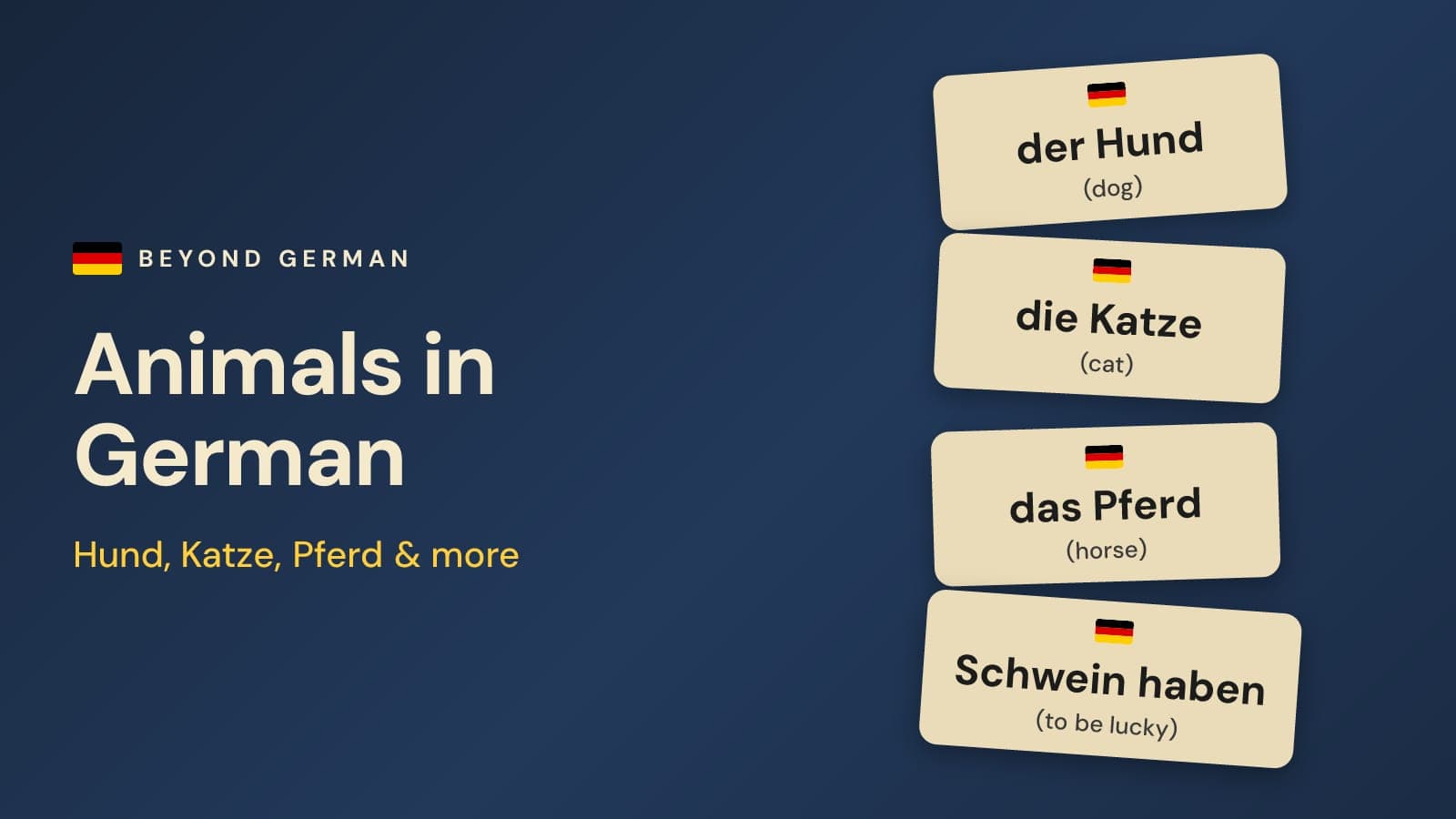
The most common animals in German are der Hund (dog), die Katze (cat), das Pferd (horse), die Kuh (cow), das Schwein (pig), der Vogel (bird) and der Fisch (fish). The word for animal is das Tier (plural die Tiere). Every animal name has its own gender and plural, so learn them together: der Hund, die Hunde.
Below you'll find pets, farm animals, wild animals, zoo animals and insects, each with its article and plural, plus male and female forms, what animals "say" in German and the animal idioms Germans love.
Pets in German: Haustiere
A pet is das Haustier, literally a "house animal". These are the ones you'll talk about most:
| German | Plural | English |
|---|---|---|
| der Hund | die Hunde | dog |
| die Katze | die Katzen | cat |
| das Kaninchen | die Kaninchen | rabbit |
| der Hamster | die Hamster | hamster |
| das Meerschweinchen | die Meerschweinchen | guinea pig |
| der Wellensittich | die Wellensittiche | budgie, parakeet |
| der Vogel | die Vögel | bird |
| der Fisch | die Fische | fish |
- Hast du ein Haustier? — Do you have a pet?
- Ja, ich habe einen Hund und zwei Katzen. — Yes, I have a dog and two cats.
- Ich gehe mit dem Hund Gassi. — I'm taking the dog for a walk.
- Kaninchen or Hase? Strictly speaking, das Kaninchen is a rabbit and der Hase is a hare. In everyday German, though, many people call rabbits Hasen too, and the Easter Bunny is der Osterhase.
- Das Meerschweinchen (guinea pig) is literally a "little sea pig".
- Gassi gehen is the everyday phrase for walking the dog, and you'll hear it from dog owners all the time.
Farm Animals: Tiere auf dem Bauernhof
| German | Plural | English |
|---|---|---|
| die Kuh | die Kühe | cow |
| das Schwein | die Schweine | pig |
| das Pferd | die Pferde | horse |
| das Schaf | die Schafe | sheep |
| die Ziege | die Ziegen | goat |
| das Huhn | die Hühner | chicken, hen |
| der Hahn | die Hähne | rooster |
| die Ente | die Enten | duck |
| die Gans | die Gänse | goose |
| der Esel | die Esel | donkey |
- Die Kühe stehen auf der Weide. — The cows are out in the pasture.
- Unsere Hühner legen jeden Tag Eier. — Our hens lay eggs every day.
Look at the plurals in the first two tables and you'll see the main patterns. Most masculine and neuter animals add -e (Hunde, Fische, Schafe), feminine ones add -(e)n (Katzen, Ziegen, Enten), words ending in -chen, -el or -er don't add an ending (Kaninchen, Esel, Hamster), and many add an umlaut on top (Kühe, Gänse, Vögel, Hühner). Our guide to German plural rules explains all five patterns.
On a menu, the meat usually has its own word: das Schweinefleisch (pork), das Rindfleisch (beef, from das Rind, cattle) and das Hähnchen (chicken).
Wild Animals: Tiere im Wald
These are the animals you might spot in a German forest (der Wald), or even in a city park:
| German | Plural | English |
|---|---|---|
| der Bär | die Bären | bear |
| der Wolf | die Wölfe | wolf |
| der Fuchs | die Füchse | fox |
| das Reh | die Rehe | roe deer |
| der Hirsch | die Hirsche | deer, stag |
| das Wildschwein | die Wildschweine | wild boar |
| der Igel | die Igel | hedgehog |
| das Eichhörnchen | die Eichhörnchen | squirrel |
| die Maus | die Mäuse | mouse |
| die Eule | die Eulen | owl |
Reh or Hirsch? English "deer" covers both, but German doesn't. Das Reh is the small roe deer, and der Hirsch is the much bigger red deer, famous for the male's huge antlers. And no, a Reh isn't a female Hirsch: they're two different species, a mix-up even many Germans make.
- Im Garten wohnt ein Igel. — A hedgehog lives in the garden.
- Das Eichhörnchen sammelt Nüsse. — The squirrel is collecting nuts.
Zoo Animals: Tiere im Zoo
| German | Plural | English |
|---|---|---|
| der Löwe | die Löwen | lion |
| der Tiger | die Tiger | tiger |
| der Elefant | die Elefanten | elephant |
| die Giraffe | die Giraffen | giraffe |
| der Affe | die Affen | monkey, ape |
| das Zebra | die Zebras | zebra |
| der Eisbär | die Eisbären | polar bear |
| der Pinguin | die Pinguine | penguin |
| die Schlange | die Schlangen | snake |
Watch out for weak nouns. Der Löwe, der Affe, der Elefant and der Bär add -(e)n in every case except the nominative singular:
- Im Zoo haben wir einen Elefanten gesehen. — We saw an elephant at the zoo.
- Das Kind hat Angst vor dem Löwen. — The child is afraid of the lion.
Two fun ones: der Eisbär is literally an "ice bear", and die Schlange also means a line of people: Wir müssen Schlange stehen. — We have to stand in line.
Insects and Spiders
The general word is das Insekt (plural die Insekten).
| German | Plural | English |
|---|---|---|
| die Biene | die Bienen | bee |
| die Wespe | die Wespen | wasp |
| die Fliege | die Fliegen | fly |
| die Mücke | die Mücken | mosquito |
| die Ameise | die Ameisen | ant |
| der Schmetterling | die Schmetterlinge | butterfly |
| der Marienkäfer | die Marienkäfer | ladybug, ladybird |
| die Spinne | die Spinnen | spider |
- The -e clue: most of these end in -e, a very common feminine ending, so they're die: die Biene, die Fliege, die Spinne.
- Mosquitoes sting in German: Mich hat eine Mücke gestochen. — A mosquito bit me. Germans normally say stechen (to sting), not beißen (to bite).
- Making a fuss? Mach doch nicht aus einer Mücke einen Elefanten! — Don't make a mountain out of a molehill! (Literally: don't make an elephant out of a mosquito.)
Male, Female and Baby Animals
Normally, one word covers every animal of a kind: any cat is die Katze, any giraffe die Giraffe, any dog der Hund. The article tells you nothing about the animal's sex. For pets and farm animals, though, German has extra words:
| Animal | Male | Female | Young |
|---|---|---|---|
| dog | der Hund (der Rüde) | die Hündin | der Welpe |
| cat | der Kater | die Katze | das Kätzchen |
| cattle (das Rind) | der Stier / der Bulle | die Kuh | das Kalb |
| horse | der Hengst | die Stute | das Fohlen |
| pig | der Eber | die Sau | das Ferkel |
| chicken | der Hahn | die Henne | das Küken |
- Dogs: in everyday German, a male dog is simply der Hund. Der Rüde is the term vets and breeders use.
- Cats: die Katze is any cat and also a female one. Unser Kater heißt Felix. — Our tomcat is called Felix.
- -in for females: many animals add -in, often with an umlaut: der Löwe – die Löwin, der Wolf – die Wölfin, der Fuchs – die Füchsin, der Bär – die Bärin. The plural ends in -innen: die Hündinnen.
- Babies: many baby animals are neuter, like das Kind: das Kalb, das Fohlen, das Ferkel, das Küken. The exception here is der Welpe (puppy).
Diminutives: Kätzchen, Hündchen and Co.
Add -chen (or the more literary -lein) to an animal, usually with an umlaut, and you get a small or cute version. The result is always neuter, whatever the original gender. It's one of the few German gender rules with no exceptions, and our guide to der, die, das rules has more clues like it.
- die Katze → das Kätzchen (kitten)
- der Hund → das Hündchen (little dog, doggy)
- die Maus → das Mäuschen (little mouse)
- der Bär → das Bärchen (little bear, as in Gummibärchen, gummy bears)
- die Ente → das Entlein (duckling, as in Das hässliche Entlein, The Ugly Duckling)
The plural doesn't change: ein Kätzchen, zwei Kätzchen. Some everyday animal names are -chen words too, so they're always neuter: das Kaninchen, das Eichhörnchen, das Meerschweinchen. Germans even use them as pet names for people: Mäuschen, Häschen and Bärchen are classic terms of endearment.
Animal Sounds in German
Animals don't speak German, but Germans hear them a little differently:
| Animal | German | English | Verb |
|---|---|---|---|
| der Hund | wau wau | woof woof | bellen |
| die Katze | miau | meow | miauen |
| die Kuh | muh | moo | muhen |
| der Hahn | kikeriki | cock-a-doodle-doo | krähen |
| das Schaf | mäh | baa | blöken |
| die Ziege | meck meck | maa | meckern |
| das Schwein | grunz grunz | oink oink | grunzen |
| die Ente | quak quak | quack quack | quaken |
| der Vogel | piep piep | tweet tweet | zwitschern |
| die Biene | summ summ | buzz | summen |
- Der Hund bellt die ganze Nacht. — The dog barks all night.
- Der Hahn kräht jeden Morgen um fünf. — The rooster crows every morning at five.
Meckern has a second meaning you'll hear a lot: to grumble. Hör auf zu meckern! — Stop moaning!
German Animal Idioms
| Idiom | Literally | Meaning |
|---|---|---|
| Schwein haben | to have pig | to be lucky |
| einen Kater haben | to have a tomcat | to have a hangover |
| die Katze im Sack kaufen | to buy the cat in the sack | to buy something without seeing it first (a pig in a poke) |
| Da steppt der Bär. | The bear tap-dances there. | That's where the party is. |
| Ich glaub, mein Schwein pfeift! | I think my pig is whistling! | I don't believe it! Are you kidding me? |
| mit den Hühnern ins Bett gehen | to go to bed with the chickens | to go to bed very early |
- Der Zug hatte Verspätung, also habe ich ihn noch erreicht. Schwein gehabt! — The train was late, so I still caught it. Lucky me!
- Nach der Party hatte ich einen Kater. — After the party I had a hangover.
- Ich will die Wohnung erst sehen. Ich kaufe doch nicht die Katze im Sack! — I want to see the apartment first. I'm not buying it sight unseen!
- Komm am Samstag mit, da steppt der Bär! — Come along on Saturday, it's going to be a great party!
- Du hast mein Fahrrad verkauft? Ich glaub, mein Schwein pfeift! — You sold my bike? You've got to be kidding me!
- Mein Opa geht immer mit den Hühnern ins Bett. — My grandpa always goes to bed really early.
Pigs really are lucky in Germany: at New Year, people give each other little marzipan pigs as good-luck charms. And Ich habe einen Kater can mean "I have a tomcat" or "I have a hangover", so context decides.
Three more you'll hear: einen Vogel haben (to be nuts, literally "to have a bird"), Da liegt der Hund begraben (that's the heart of the problem, literally "that's where the dog is buried") and the very casual keinen Bock haben (to not feel like it, literally "to have no billy goat"). For more, see our collection of funny German idioms and what they mean.
Common Mistakes With Animals
| Instead of | Say | Why |
|---|---|---|
| Ich habe ein Hund. | Ich habe einen Hund. | Haben takes the accusative, so masculine ein becomes einen. |
| Ich sehe den Bär. | Ich sehe den Bären. | In standard German, Bär, Löwe, Affe and Elefant are weak nouns and add -(e)n. |
| die Kätzchen (one kitten) | das Kätzchen | Nouns ending in -chen are always neuter. |
| zwei Schaf, zwei Fisch | zwei Schafe, zwei Fische | Unlike English "sheep" and "fish", the German words have plural forms. |
| Wo ist die Katze? – Er ist im Garten. | Wo ist die Katze? – Sie ist im Garten. | The pronoun follows the noun's gender, not the animal's sex. |
Practice: Animals in German
Name the animals you see every day, always with the article: the neighbor's dog, the pigeons in the square (die Tauben), the bee on your balcony. Then try these:
- der Hund, zwei ___
- die Maus, zwei ___
- ___ Kätzchen (der, die or das?)
- Ich habe ___ Hund. (ein)
- A female dog is ___.
- What does a German rooster say?
- What does Schwein gehabt! mean?
Answers:
- zwei Hunde
- zwei Mäuse
- das Kätzchen
- Ich habe einen Hund.
- die Hündin
- Kikeriki!
- Lucky me! / That was lucky!
Then test yourself in our A1 German quiz.
FAQ
How do you say "dog" in German?
Der Hund, plural die Hunde. A female dog is die Hündin, and a puppy is der Welpe.
What is the German word for "animal"?
Das Tier, plural die Tiere. A pet is das Haustier.
Why is it "das Kätzchen" if cat is "die Katze"?
The ending -chen makes every noun neuter, whatever its original gender. The same goes for das Hündchen and das Mäuschen.
What does "Schwein haben" mean?
It means to be lucky. Schwein gehabt! — That was lucky!
What sound does a dog make in German?
Wau wau. The verb is bellen: Der Hund bellt. — The dog barks.
Level Up Your German
Join 1,000+ learners getting weekly tips, grammar shortcuts, and cultural insights.
Share this article
Continue Reading
Funny German Idioms: 25 Sayings With English Translations
From Ich verstehe nur Bahnhof to Schwein haben: 25 funny German idioms with literal translations, real meanings, English equivalents and example sentences.
German Word Order: Verb-Second Rule, Verb at the End & TeKaMoLo
German word order in 7 rules: verb second, verb first in yes/no questions, verb last after weil and dass, the verb bracket, TeKaMoLo, object order and where nicht goes.
How to Be Polite in German: Würde, Könnte, Hätte gern & More
Sound polite in German with Konjunktiv II: Ich hätte gern, Könnten Sie, Würden Sie and Dürfte ich, plus softening words, Sie vs. du, polite refusals and dialogues.