
Body Parts in German: Vocabulary With Articles & Plurals
 Beyond German Team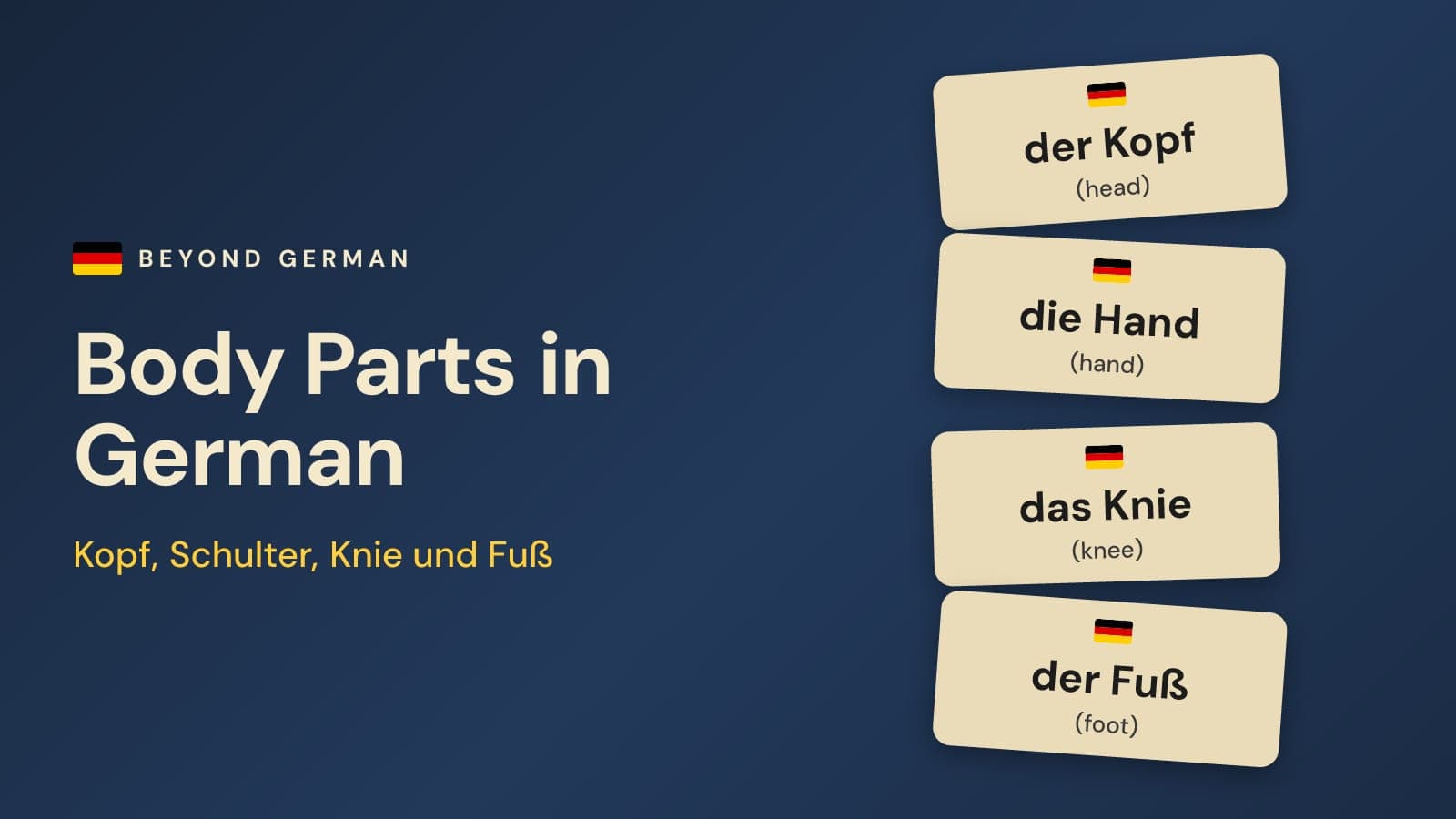
The most important body parts in German are der Kopf (head), das Auge (eye), die Nase (nose), der Mund (mouth), die Hand (hand), der Arm (arm), das Bein (leg) and der Fuß (foot). The body itself is der Körper, and body parts are die Körperteile. Every body part has its own article and plural, so learn them in pairs: die Hand, die Hände.
Below you'll find all the essential body parts in tables, how to say "I wash my hands" the German way, how to say what hurts, the German version of "Head, Shoulders, Knees and Toes" (Kopf, Schulter, Knie und Fuß) and the body idioms Germans use every day.
The Head and Face: der Kopf und das Gesicht
Start at the top. The head and face words come in all three genders, and even the usually reliable -e ending lets you down here: die Nase and die Zunge are feminine, but das Auge is neuter. So learn each word with its article.
| German | Plural | English |
|---|---|---|
| der Kopf | die Köpfe | head |
| das Gesicht | die Gesichter | face |
| das Auge | die Augen | eye |
| das Ohr | die Ohren | ear |
| die Nase | die Nasen | nose |
| der Mund | die Münder | mouth |
| der Zahn | die Zähne | tooth |
| die Zunge | die Zungen | tongue |
| das Haar | die Haare | hair |
| der Hals | die Hälse | neck, throat |
- Haar or Haare? For the hair on your head, Germans usually use the plural: Sie hat lange Haare. — She has long hair. The singular works too and sounds a little more formal (Sie hat langes Haar), and ein Haar is one single hair.
- Der Hals is both your neck and your throat. The back of your neck is der Nacken.
- More face words: die Stirn (forehead), die Wange (cheek), das Kinn (chin), die Lippe (lip), die Augenbraue (eyebrow) and der Bart (beard).
- Sie hat blaue Augen. — She has blue eyes.
- Er hat kurze Haare und einen Bart. — He has short hair and a beard.
- Das Baby hat schon zwei Zähne. — The baby already has two teeth.
The Body: Arms, Hands, Legs and Feet
| German | Plural | English |
|---|---|---|
| die Schulter | die Schultern | shoulder |
| der Arm | die Arme | arm |
| die Hand | die Hände | hand |
| der Finger | die Finger | finger |
| der Daumen | die Daumen | thumb |
| die Brust | die Brüste | chest; breast |
| der Bauch | die Bäuche | belly, stomach |
| der Rücken | die Rücken | back |
| das Bein | die Beine | leg |
| das Knie | die Knie | knee |
| der Fuß | die Füße | foot |
| der Zeh / die Zehe | die Zehen | toe |
- Umlaut plurals: Hand – Hände, Fuß – Füße, Bauch – Bäuche, just like Kopf – Köpfe and Zahn – Zähne. English has the same leftovers: foot – feet, tooth – teeth.
- No change at all: Knie, Finger, Daumen and Rücken look the same in the plural: ein Knie, zwei Knie.
- Toe can be der Zeh or die Zehe. Both are correct, and the plural is always die Zehen.
- Die Brust is your chest, so it stays singular: Mir tut die Brust weh. — My chest hurts. The plural, die Brüste, means a woman's breasts.
- More body words: der Ellbogen (elbow), das Handgelenk (wrist), die Hüfte (hip), der Knöchel (ankle) and die Haut (skin).
- Er hat lange Beine. — He has long legs.
- Gib mir die Hand! — Give me your hand!
- Ich habe kalte Füße. — My feet are cold. (And just like in English, kalte Füße bekommen also means to get cold feet.)
Inside the Body: Organs
| German | Plural | English |
|---|---|---|
| das Herz | die Herzen | heart |
| die Lunge | die Lungen | lungs |
| der Magen | die Mägen | stomach |
| das Gehirn | die Gehirne | brain |
| die Leber | die Lebern | liver |
| die Niere | die Nieren | kidney |
- Die Lunge is singular where English says "lungs", because German treats both lungs as one organ: Rauchen schadet der Lunge. — Smoking damages your lungs.
- Das Herz has irregular forms, like dem Herzen in the dative: Ich danke dir von ganzem Herzen. — I thank you with all my heart.
- Bauch or Magen? Der Bauch is your belly, the whole area you can see and touch. Der Magen is the organ inside: Ich habe mir den Magen verdorben. — I've got an upset stomach (from something I ate).
Kopf, Schulter, Knie und Fuß: The German Song
"Head, Shoulders, Knees and Toes" is Kopf, Schulter, Knie und Fuß in German, and it's a favorite in German kindergartens. You touch each body part as you sing it, crouch down for Knie und Fuß, and sing a little faster every round until everyone gets tangled up. The traditional words:
| German | English |
|---|---|
| Kopf und Schulter, Knie und Fuß, Knie und Fuß, | Head and shoulder, knee and foot, knee and foot, |
| Kopf und Schulter, Knie und Fuß, Knie und Fuß, | Head and shoulder, knee and foot, knee and foot, |
| und Augen, Ohren, Nase, Mund, | and eyes, ears, nose, mouth, |
| Kopf und Schulter, Knie und Fuß, Knie und Fuß! | Head and shoulder, knee and foot, knee and foot! |
Two differences from English: German sings Fuß (foot) where English sings "toes", and Schulter and Fuß are singular. Some versions sing Kopf und Schultern, so don't worry if you hear it slightly differently. Sing it fast a few times and you'll never forget these eight words.
"My Hands" in German: The Dative Instead of mein
In English, you wash your hands and brush your teeth. German usually skips "my" here. Instead, it uses der/die/das plus a dative pronoun like mir (to me), which already shows whose body it is:
- Ich wasche mir die Hände. — I wash my hands.
- Ich putze mir die Zähne. — I brush my teeth.
- Sie kämmt sich die Haare. — She combs her hair.
- Er hat sich das Bein gebrochen. — He broke his leg.
Ich wasche meine Hände isn't wrong, but it sounds like a word-for-word translation, or as if you're stressing that they're your hands and not someone else's. The pronoun changes with the person:
| Person | German | English |
|---|---|---|
| ich → mir | Ich wasche mir die Hände. | I wash my hands. |
| du → dir | Wasch dir die Hände! | Wash your hands! |
| er/sie → sich | Er wäscht sich die Hände. | He washes his hands. |
| wir → uns | Wir waschen uns die Hände. | We wash our hands. |
| ihr → euch | Wascht euch die Hände! | Wash your hands! (to several people) |
| sie (they) → sich | Die Kinder waschen sich die Hände. | The children wash their hands. |
It works for other people too: Die Mutter wäscht dem Kind die Hände. — The mother washes the child's hands. The person goes in the dative (dem Kind), the body part in the accusative (die Hände). If that's new to you, our guide to the German dative case explains how it works.
Saying What Hurts: Mir tut … weh vs. Ich habe …schmerzen
German has two everyday ways to say that something hurts, and both are easy once you know the body parts.
Going to the doctor? Our guide to German at the doctor covers the rest of your visit: making an appointment, describing symptoms, understanding the doctor and getting medicine at the pharmacy.
1. Mir tut … weh
Here the body part is the subject, and the person in pain is in the dative, just like in Ich wasche mir die Hände:
- Mir tut der Kopf weh. — My head hurts.
- Mir tut der Rücken weh. — My back hurts.
- Mir tun die Füße weh. — My feet hurt.
- Tut dir das Knie noch weh? — Does your knee still hurt?
- Wo tut es weh? — Where does it hurt?
Because the body part is the subject, the verb agrees with it: one foot tut weh, two feet tun weh. And wehtun is a separable verb, so weh goes to the end.
2. Ich habe …schmerzen
Or put the body part in front of Schmerzen (pains) and use haben. The classic is Ich habe Kopfschmerzen — I have a headache.
| Body part | Pain | English |
|---|---|---|
| der Kopf | Kopfschmerzen | headache |
| der Hals | Halsschmerzen | sore throat |
| der Bauch | Bauchschmerzen | stomachache |
| der Rücken | Rückenschmerzen | back pain |
| der Zahn | Zahnschmerzen | toothache |
| das Ohr | Ohrenschmerzen | earache |
| der Nacken | Nackenschmerzen | neck pain |
- Ich habe seit gestern Zahnschmerzen. — I've had a toothache since yesterday.
- Hast du Halsschmerzen? — Do you have a sore throat?
- Ich habe Schmerzen in der Schulter. — I have pain in my shoulder.
Germans normally use the plural with no article: Ich habe Kopfschmerzen, not einen Kopfschmerz. In casual speech, you'll also hear Kopfweh, Bauchweh and Zahnweh: Ich habe Bauchweh. — I've got a tummy ache.
Which One Should You Use?
Both are correct and very common. Mir tut … weh works with any body part, even ones without a ready-made compound (Mir tut der kleine Finger weh). The -schmerzen words are a bit more neutral, and they're what you'll read on a packet of painkillers.
Body Part Idioms
German loves idioms with body parts. These five come up all the time:
| Idiom | Literally | Meaning |
|---|---|---|
| Hals- und Beinbruch! | Neck and leg fracture! | Good luck! (like "Break a leg!") |
| jemandem auf den Keks gehen | to go on someone's cookie | to get on someone's nerves |
| die Nase voll haben | to have your nose full | to be fed up |
| ein Auge zudrücken | to squeeze one eye shut | to turn a blind eye, let something slide |
| jemandem die Daumen drücken | to press your thumbs for someone | to keep your fingers crossed for someone |
- Morgen ist deine Prüfung? Hals- und Beinbruch! — Your exam is tomorrow? Good luck!
- Du gehst mir auf den Keks! — You're getting on my nerves!
- Ich habe die Nase voll von diesem Regen. — I'm fed up with this rain.
- Diesmal drücke ich noch ein Auge zu. — This time I'll let it slide.
- Ich drücke dir die Daumen! — I'll keep my fingers crossed for you!
Why a cookie? In casual German, der Keks is also slang for your head. And Germans really do press their thumbs instead of crossing their fingers: they tuck each thumb inside a fist and squeeze.
A few more you'll hear:
- zwei linke Hände haben — to be clumsy (literally: to have two left hands)
- sich Hals über Kopf verlieben — to fall head over heels in love (literally: neck over head)
- kein Blatt vor den Mund nehmen — to speak your mind (literally: to put no leaf in front of your mouth)
- sich den Kopf zerbrechen — to rack your brains (literally: to break your head)
For more like these, see our collection of funny German idioms and what they mean.
Common Mistakes With Body Parts
| Instead of | Say | Why |
|---|---|---|
| Ich wasche meine Hände. | Ich wasche mir die Hände. | With body parts, German prefers a dative pronoun plus der/die/das. |
| Ich habe meinen Arm gebrochen. | Ich habe mir den Arm gebrochen. | The same pattern works for injuries. |
| Mir tut die Füße weh. | Mir tun die Füße weh. | The verb agrees with the body part, and Füße is plural. |
| Ich habe Halsschmerzen. (for a stiff neck) | Mir tut der Nacken weh. | Halsschmerzen means a sore throat. |
| die Auge | das Auge | It ends in -e, but it's neuter. |
| Meine Haare ist lang. | Meine Haare sind lang. | Haare is plural, so the verb is too. |
| zwei Hande, zwei Fuße | zwei Hände, zwei Füße | Don't forget the umlaut in the plural. |
Practice: Body Parts in German
The best way to learn body parts is to use your own body. Every morning, touch five body parts and name them out loud with their articles: der Kopf, die Nase, das Knie… Then try these:
- das Auge, zwei ___
- der Fuß, zwei ___
- ___ Knie (der, die or das?)
- I brush my teeth.
- My feet hurt.
- I have a sore throat.
- I'll keep my fingers crossed for you!
Answers:
- zwei Augen
- zwei Füße
- das Knie
- Ich putze mir die Zähne.
- Mir tun die Füße weh.
- Ich habe Halsschmerzen.
- Ich drücke dir die Daumen!
Then test yourself in our A1 German quiz.
FAQ
How do you say "body parts" in German?
Die Körperteile. The body is der Körper, and one part of it is ein Körperteil.
What is "Head, Shoulders, Knees and Toes" in German?
Kopf, Schulter, Knie und Fuß. German sings "foot" instead of "toes", and the third line is und Augen, Ohren, Nase, Mund.
How do you say "my head hurts" in German?
Mir tut der Kopf weh. or Ich habe Kopfschmerzen. Both are correct and equally common.
Is it der, die or das Knie?
Das Knie. The plural looks the same: die Knie.
What does "Hals- und Beinbruch" mean?
It means "Good luck!", like "Break a leg!" in English. Literally, it wishes you a broken neck and a broken leg, so don't take it personally.
Level Up Your German
Join 1,000+ learners getting weekly tips, grammar shortcuts, and cultural insights.
Share this article
Continue Reading
Funny German Idioms: 25 Sayings With English Translations
From Ich verstehe nur Bahnhof to Schwein haben: 25 funny German idioms with literal translations, real meanings, English equivalents and example sentences.
German Word Order: Verb-Second Rule, Verb at the End & TeKaMoLo
German word order in 7 rules: verb second, verb first in yes/no questions, verb last after weil and dass, the verb bracket, TeKaMoLo, object order and where nicht goes.
How to Be Polite in German: Würde, Könnte, Hätte gern & More
Sound polite in German with Konjunktiv II: Ich hätte gern, Könnten Sie, Würden Sie and Dürfte ich, plus softening words, Sie vs. du, polite refusals and dialogues.